HTTP 200 OK
Allow: GET, HEAD, OPTIONS
Content-Type: application/json
Vary: Accept
{
"result": [
{
"id": 566,
"author": "Khatapana",
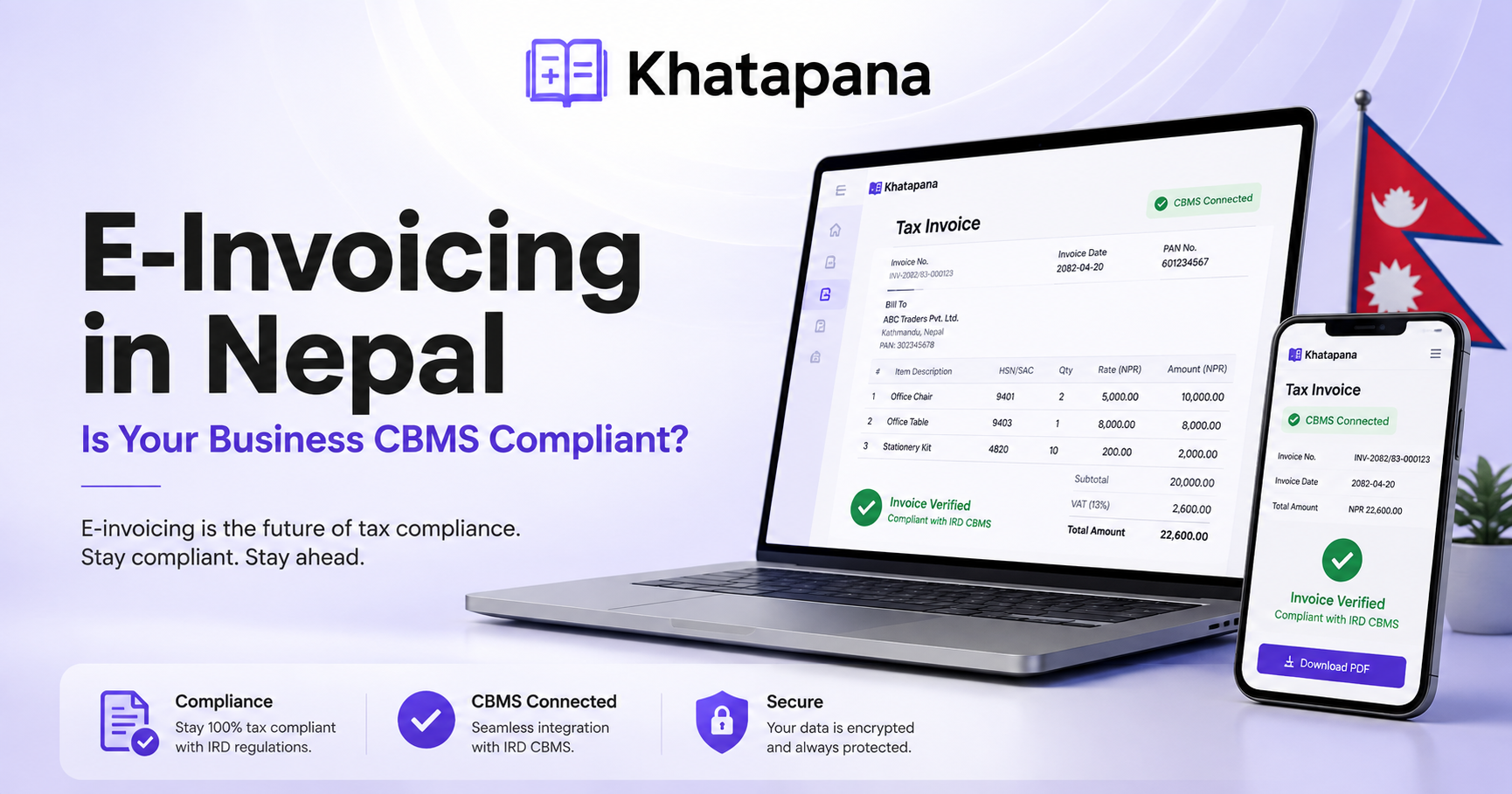
"title": "E-Billing (E-Invoicing) in Nepal 2026: Is It Compulsory for Your Business?",
"content": "<p><span style=\"background-color:transparent;color:#000000;\"><i><strong>Confused about e-billing in Nepal? We break down CBMS thresholds, who must comply, and what happens if you don't. Read more to find out.</strong></i></span></p><p><span style=\"background-color:transparent;color:#000000;\">A retail clothing shop owner in Kathmandu got a call from his accountant last month. Turns out the IRD had flagged his business for not being connected to something called CBMS. He'd never even heard the term before. And it's not like he did anything wrong exactly, his shop just did well the past two years, his turnover kept climbing, and somewhere in there he quietly crossed a line into having to comply with this whole system without anyone explicitly telling him.</span></p><p><span style=\"background-color:transparent;color:#000000;\">That's the issue with e-billing in Nepal right now. Nobody sends you a welcome email when you cross the threshold. For FY 2083/084, the government has widened who falls under its electronic billing and CBMS requirements, and the IRD has been actively issuing notices to businesses that haven't connected yet. </span></p><p><span style=\"background-color:transparent;color:#000000;\">This piece walks through what e-billing actually is, who's on the hook this year, how the system works day to day, and what to do if you think you might be one of them.</span></p><h2><span style=\"background-color:transparent;color:#000000;\"><strong>Nepal Is Moving From Tax Returns to Transaction-Level Monitoring</strong></span></h2><p><span style=\"background-color:transparent;color:#000000;\">To understand why CBMS exists, let’s look at how the old system worked. Under the traditional flow, a business issues an invoice, records the sale in its own books, and reports a summary to the IRD months later through a VAT return. Between the invoice and the return sits a lot of room for gaps (some accidental, some not) between what was actually sold and what got reported.</span></p><p><span style=\"background-color:transparent;color:#000000;\">CBMS closes that gap by moving the reporting point earlier. Instead of a business → books → VAT return → IRD chain, e-invoicing creates a shorter path that looks something like this: business → invoice → CBMS → IRD, with the transaction visible to the tax department almost as it happens. </span></p><p><span style=\"background-color:transparent;color:#000000;\">And no, it’s not entirely about making VAT filings digital. There’s more to the story here. With CBMS, the government aims to shift tax administration from periodic reporting toward continuous, transaction-level visibility. And Nepal has been building toward this since a pilot with roughly six hundred large taxpayers back in 2017.</span></p><h2><span style=\"background-color:transparent;color:#000000;\"><strong>First, What Exactly Is E-Billing?</strong></span></h2><p><span style=\"background-color:transparent;color:#000000;\">Before going further, let’s clear up a few terminologies that we use interchangeably throughout the article. </span></p><ul><li><span style=\"background-color:transparent;color:#000000;\"><strong>E-billing</strong> (also called electronic billing) is the overall process of issuing invoices through IRD-approved software that follows a prescribed format.</span></li><li><span style=\"background-color:transparent;color:#000000;\"><strong>CBMS</strong>, the Central Billing Monitoring System, is the specific IRD platform that receives and monitors that billing data.</span></li><li><span style=\"background-color:transparent;color:#000000;\">An <strong>e-invoice</strong> is simply the individual bill produced inside that process.</span></li></ul><p><span style=\"background-color:transparent;color:#000000;\">In short, e-billing is the process, CBMS is where the data lands, and an e-invoice is the document itself. Importantly, none of this happens automatically just because you use a computer. A Word or Excel invoice, however neatly formatted, is not an e-bill.</span></p><p><span style=\"background-color:transparent;color:#000000;\"><strong>E-billing is not </strong>emailing an invoice as a PDF, or typing an invoice in Word or Excel, or printing a bill from ordinary, unapproved accounting software, or even scanning a handwritten paper invoice</span></p><p><span style=\"background-color:transparent;color:#000000;\"><strong>E-billing is </strong>issuing bills through IRD-approved software, following the required invoice format and sequential numbering, and transmitting invoice data to CBMS where your business is mandated to do so</span></p><h2><span style=\"background-color:transparent;color:#000000;\"><strong>What's Changed for FY 2083/084?</strong></span></h2><p><span style=\"background-color:transparent;color:#000000;\"><img src=\"https://khatapana.s3.ap-south-1.amazonaws.com/media/image_RjmezVF.jpeg\" width=\"509\" height=\"387\"></span></p><p><span style=\"background-color:transparent;color:#000000;\">As per IRD's notice published on Baisakh 3, 2083, the general threshold for mandatory CBMS connection is annual turnover exceeding NPR 20 crore. That's the figure most businesses will need to check themselves against. Sector-specific thresholds, such as a lower bar for hospitality businesses, sit outside this particular notice and are worth confirming directly with the IRD rather than assuming the general figure applies to you.</span></p><p><span style=\"background-color:transparent;color:#000000;\">There's also an interesting contrast running through this year's policy changes. The Startup Fast-Track Action Plan 2026 has eased some compliance load elsewhere, letting new startups file tax returns annually instead of quarterly for their first three years. At the same time, e-invoicing requirements have widened. In other words, the government is moving towards more targeted, more <i>digital </i>compliance, and easing paperwork in one place while tightening transaction-level visibility in another.</span></p><h2><span style=\"background-color:transparent;color:#000000;\"><strong>Does Your Business Fall Under the Requirement?</strong></span></h2><p><span style=\"background-color:transparent;color:#000000;\">The NPR 20 crore figure shouldn't be read as a universal exemption for everyone below it. Coverage depends on several separate factors, not one number.</span></p><div style=\"margin-left:0pt;\" dir=\"ltr\" align=\"left\"><figure class=\"table\"><table style=\"border-style:none;\"><tbody><tr><td style=\"padding:5pt;vertical-align:top;\"><p style=\"text-align:center;\"><span style=\"background-color:transparent;color:#000000;\"><strong>Situation</strong></span></p></td><td style=\"padding:5pt;vertical-align:top;\"><p style=\"text-align:center;\"><span style=\"background-color:transparent;color:#000000;\"><strong>Where you likely stand</strong></span></p></td></tr><tr><td style=\"padding:5pt;vertical-align:top;\"><span style=\"background-color:transparent;color:#000000;\">Turnover above NPR 20 crore</span></td><td style=\"padding:5pt;vertical-align:top;\"><span style=\"background-color:transparent;color:#000000;\">Generally within the FY 2083/084 threshold</span></td></tr><tr><td style=\"padding:5pt;vertical-align:top;\"><span style=\"background-color:transparent;color:#000000;\">In a prescribed sector (hotels, restaurants, alcohol, cigarettes, construction)</span></td><td style=\"padding:5pt;vertical-align:top;\"><span style=\"background-color:transparent;color:#000000;\">Check the sector-specific threshold separately</span></td></tr><tr><td style=\"padding:5pt;vertical-align:top;\"><span style=\"background-color:transparent;color:#000000;\">Already classified as a Large Taxpayer by the IRD</span></td><td style=\"padding:5pt;vertical-align:top;\"><span style=\"background-color:transparent;color:#000000;\">May already be covered under existing rules</span></td></tr><tr><td style=\"padding:5pt;vertical-align:top;\"><span style=\"background-color:transparent;color:#000000;\">You supply government bodies (B2G)</span></td><td style=\"padding:5pt;vertical-align:top;\"><span style=\"background-color:transparent;color:#000000;\">Existing e-invoicing requirements have applied since earlier phases</span></td></tr><tr><td style=\"padding:5pt;vertical-align:top;\"><span style=\"background-color:transparent;color:#000000;\">Individually notified by the IRD</span></td><td style=\"padding:5pt;vertical-align:top;\"><span style=\"background-color:transparent;color:#000000;\">Must comply per that specific notice, regardless of turnover</span></td></tr><tr><td style=\"padding:5pt;vertical-align:top;\"><span style=\"background-color:transparent;color:#000000;\">Below the threshold and none of the above apply</span></td><td style=\"padding:5pt;vertical-align:top;\"><span style=\"background-color:transparent;color:#000000;\">Not currently mandated, but worth rechecking each fiscal year</span></td></tr></tbody></table></figure></div><p><span style=\"background-color:transparent;color:#000000;\">A restaurant doing NPR 4 crore a year sits comfortably under the general threshold but could still fall inside a lower, sector-specific one. That's exactly the kind of gap that catches business owners off guard, so it's worth checking each category on its own before you assume anything. </span></p><h2><span style=\"background-color:transparent;color:#000000;\"><strong>What Happens When You Issue an E-Bill?</strong></span></h2><p><span style=\"background-color:transparent;color:#000000;\">Say that same restaurant issues a bill for NPR 11,300. Under a CBMS-connected setup, the relevant transaction details, buyer information, PAN, amount, date, get transmitted to CBMS at the same time. The restaurant's internal sales records and what the tax authority can see are no longer two separate worlds.</span></p><p><span style=\"background-color:transparent;color:#000000;\">Now suppose the cashier types NPR 1,130 instead of NPR 11,300. On a spreadsheet, someone would just fix the number and move on. Inside a CBMS-connected e-invoicing system, that original transaction can not be overwritten. Once a bill is transmitted, it's locked, and the correction has to follow the prescribed process, typically a credit note against the original invoice, rather than editing the number directly. Anyone used to manual bookkeeping, where a typo just gets retyped, will need to unlearn that habit.</span></p><h2><span style=\"background-color:transparent;color:#000000;\"><strong>E-Billing vs Ordinary Computerized Billing: What’s the Difference?</strong></span></h2><div style=\"margin-left:0pt;\" dir=\"ltr\" align=\"left\"><figure class=\"table\"><table style=\"border-style:none;\"><tbody><tr><td style=\"padding:5pt;vertical-align:top;\"> </td><td style=\"padding:5pt;vertical-align:top;\"><p style=\"text-align:center;\"><span style=\"background-color:transparent;color:#000000;\"><strong>Ordinary computerized invoice</strong></span></p></td><td style=\"padding:5pt;vertical-align:top;\"><p style=\"text-align:center;\"><span style=\"background-color:transparent;color:#000000;\"><strong>E-invoicing (CBMS-connected)</strong></span></p></td></tr><tr><td style=\"padding:5pt;vertical-align:top;\"><span style=\"background-color:transparent;color:#000000;\">Where it's created</span></td><td style=\"padding:5pt;vertical-align:top;\"><span style=\"background-color:transparent;color:#000000;\">Any software, including Word/Excel</span></td><td style=\"padding:5pt;vertical-align:top;\"><span style=\"background-color:transparent;color:#000000;\">IRD-approved billing software only</span></td></tr><tr><td style=\"padding:5pt;vertical-align:top;\"><span style=\"background-color:transparent;color:#000000;\">Where the data goes</span></td><td style=\"padding:5pt;vertical-align:top;\"><span style=\"background-color:transparent;color:#000000;\">Stays with the business until filing</span></td><td style=\"padding:5pt;vertical-align:top;\"><span style=\"background-color:transparent;color:#000000;\">Transmitted to CBMS in near real time</span></td></tr><tr><td style=\"padding:5pt;vertical-align:top;\"><span style=\"background-color:transparent;color:#000000;\">Can it be edited after issue</span></td><td style=\"padding:5pt;vertical-align:top;\"><span style=\"background-color:transparent;color:#000000;\">Usually yes</span></td><td style=\"padding:5pt;vertical-align:top;\"><span style=\"background-color:transparent;color:#000000;\">No, only corrected via credit note</span></td></tr><tr><td style=\"padding:5pt;vertical-align:top;\"><span style=\"background-color:transparent;color:#000000;\">Numbering</span></td><td style=\"padding:5pt;vertical-align:top;\"><span style=\"background-color:transparent;color:#000000;\">Business's own choice</span></td><td style=\"padding:5pt;vertical-align:top;\"><span style=\"background-color:transparent;color:#000000;\">Sequential, fiscal-year based, locked</span></td></tr></tbody></table></figure></div><h2><span style=\"background-color:transparent;color:#000000;\"><strong>How to Get Your Business Connected to CBMS?</strong></span></h2><p><span style=\"background-color:transparent;color:#000000;\">If you fall under the mandate, the path looks roughly like this, and it is essential to know who's actually responsible at each stage.</span></p><ol><li><span style=\"background-color:transparent;color:#000000;\"><strong>Choose the software (business).</strong> Pick IRD-approved billing software that supports VAT compliance, real-time CBMS integration, and the correct invoice format.</span></li><li><span style=\"background-color:transparent;color:#000000;\"><strong>Set up and test (business and software provider).</strong> Run internal test transactions to confirm everything syncs correctly before going live.</span></li><li><span style=\"background-color:transparent;color:#000000;\"><strong>Prepare documentation (business).</strong> Business registration certificate, PAN/VAT certificate, software purchase agreement, sample invoices, user manual, and technical or hosting details.</span></li><li><span style=\"background-color:transparent;color:#000000;\"><strong>Submit the application (business or provider).</strong> Filed through the IRD Taxpayer Portal, under the Electronic Billing section.</span></li><li><span style=\"background-color:transparent;color:#000000;\"><strong>Inspection and approval (IRD).</strong> The department reviews the setup against its integration and data security standards.</span></li><li><span style=\"background-color:transparent;color:#000000;\"><strong>Go live (business).</strong> Once approved, transition to the CBMS-connected system within the compliance timeline the IRD has set for your case, rather than waiting until the last possible day.</span></li></ol><p><span style=\"background-color:transparent;color:#000000;\">Numbering sequences and PAN details lock in once you start issuing e-bills, so make sure to get the setup right the first time, rather than fixing it after bills have already gone out.</span></p><h2><span style=\"background-color:transparent;color:#000000;\"><strong>What Can Go Wrong?</strong></span></h2><p><span style=\"background-color:transparent;color:#000000;\">If you’re thinking registration is where you need to be the most careful, and then everything will work smoothly since you’re now using a digital platform, you couldn’t be more wrong. These are the operational habits that you should be equally; if not more careful about:</span></p><ul><li><span style=\"background-color:transparent;color:#000000;\">Entering the wrong PAN on a transmitted invoice</span></li><li><span style=\"background-color:transparent;color:#000000;\">Gaps or duplicates in invoice numbering</span></li><li><span style=\"background-color:transparent;color:#000000;\">Internet or connectivity issues at the point of sale</span></li><li><span style=\"background-color:transparent;color:#000000;\">An incorrect amount that can't simply be retyped</span></li><li><span style=\"background-color:transparent;color:#000000;\">Sales records that drift out of sync with accounting books</span></li><li><span style=\"background-color:transparent;color:#000000;\">Billing staff who haven't been trained on the correction process</span></li></ul><p><span style=\"background-color:transparent;color:#000000;\">None of these are catastrophic on their own, but each one compounds if it isn't caught early, since the data has already reached CBMS by the time anyone notices.</span></p><h2><span style=\"background-color:transparent;color:#000000;\"><strong>What Happens If You Don't Comply</strong></span></h2><p><span style=\"background-color:transparent;color:#000000;\">The consequences of non-compliance are not automatic or even identical in every case, but it does carry huge risks. Depending on the nature of the violation, it can create serious issues during a tax assessment, including questions over the validity of billing records and related VAT claims, financial penalties under the VAT Act and the Income Tax Act, and complications during audits or refund claims, since IRD systems cross-check declared figures against CBMS data. </span></p><p><span style=\"background-color:transparent;color:#000000;\">There's also a more concerning version of this problem that catches businesses off guard: using a non-compliant software. A business can issue digital invoices for months, believing it has already handled e-billing, and still be non-compliant the entire time, because none of that data ever reached the IRD. The invoices exist on the business's side, but not on the tax authority's.</span></p><p><span style=\"background-color:transparent;color:#000000;\">That gap, later on shows up as non-recognition of invoices or disallowed input tax credit. </span></p><p><span style=\"background-color:transparent;color:#000000;\">One thing to be careful about: one of it shows up gradually. It tends to surface all at once, usually during an audit, which is the worst possible moment to find out that your business's books and the IRD's version of them don't actually align. </span></p><p><span style=\"background-color:transparent;color:#000000;\"><strong>What This Means for Small Businesses</strong></span></p><p><span style=\"background-color:transparent;color:#000000;\">If your turnover sits below NPR 20 crore and none of the sector-specific or notification triggers apply, e-invoicing isn't mandatory for you right now. But the exemption isn't permanent by default. The IRD has narrowed it every fiscal year so far, and a business that's exempt today can fall into scope next year through either turnover growth or a new Finance Act provision. So, make sure to check each year, because that would be a lot cheaper than finding out mid-audit that your business has been non-compliant.</span></p><p><span style=\"background-color:transparent;color:#000000;\"><strong>How Khatapana Can Help</strong></span></p><p><span style=\"background-color:transparent;color:#000000;\">Figuring out whether you're in scope, choosing the right software, and getting through IRD's approval process can eat up weeks you don't have, especially if you're already juggling day-to-day operations.</span></p><p><span style=\"background-color:transparent;color:#000000;\">Khatapana's compliance and accounting tools are built to take this off your plate: from checking whether your turnover or sector puts you inside the e-billing mandate, to handling your VAT filings, tax clearance renewals, and bookkeeping in one place. Instead of piecing together IRD notices and third-party software comparisons yourself, you get a single dashboard, and a team that keeps track of deadlines so you don't have to.</span></p><p><span style=\"background-color:transparent;color:#000000;\">If you're unsure where your business stands, talk to </span><a href=\"https://khatapana.com/legal-compliance\"><span style=\"background-color:transparent;color:#1155cc;\"><u>Khatapana's compliance team</u></span></a><span style=\"background-color:transparent;color:#000000;\"> before your next VAT filing.</span></p><p><span style=\"background-color:transparent;color:#000000;\"><strong>Here’s a brief E-Invoicing Compliance Checklist:</strong></span></p><ul><li><span style=\"background-color:transparent;color:#000000;\">Confirm whether your business falls within the current mandate</span></li><li><span style=\"background-color:transparent;color:#000000;\">Check sector-specific thresholds separately from the general one</span></li><li><span style=\"background-color:transparent;color:#000000;\">Verify your PAN and VAT information is current</span></li><li><span style=\"background-color:transparent;color:#000000;\">Select IRD-approved billing software</span></li><li><span style=\"background-color:transparent;color:#000000;\">Complete CBMS setup and run test transactions</span></li><li><span style=\"background-color:transparent;color:#000000;\">Confirm invoice numbering is sequential and fiscal-year based</span></li><li><span style=\"background-color:transparent;color:#000000;\">Train billing staff on the correction process</span></li><li><span style=\"background-color:transparent;color:#000000;\">Reconcile billing records against your accounting books regularly</span></li></ul><h2><span style=\"background-color:transparent;color:#000000;\"><strong>Frequently Asked Questions</strong></span></h2><p><span style=\"background-color:transparent;color:#000000;\"><strong>Can I use Excel or Word for e-billing?</strong> No. Even a well-formatted spreadsheet invoice doesn't meet the e-invoicing requirement, since it isn't connected to CBMS and doesn't follow the prescribed invoice format.</span></p><p><span style=\"background-color:transparent;color:#000000;\"><strong>Does every VAT-registered business need to connect to CBMS?</strong> No. Only businesses that meet the general threshold, fall into a prescribed sector, are classified as large taxpayers, supply government bodies, or are individually notified by the IRD are currently required to connect.</span></p><p><span style=\"background-color:transparent;color:#000000;\"><strong>If I'm below NPR 20 crore, am I automatically exempt?</strong> Not necessarily. Turnover is one factor among several. A business under the general threshold can still be covered through a sector-specific rule or an individual IRD notice.</span></p><p><span style=\"background-color:transparent;color:#000000;\"><strong>Can an e-bill be cancelled once it's issued?</strong> Not by editing it. Once transmitted to CBMS, an invoice is locked, and corrections are made through a credit note against the original bill rather than altering it directly.</span></p><p><span style=\"background-color:transparent;color:#000000;\"><strong>Does CBMS replace my accounting software?</strong> No. CBMS is where transaction data is reported, not where your books live. Your accounting software still needs to reconcile with what's been transmitted.</span></p><p><span style=\"background-color:transparent;color:#000000;\"><strong>Can my accountant handle CBMS compliance for me?</strong> Much of it, yes, particularly the filings and reconciliation. But the initial software approval and technical setup usually need direct business involvement, since IRD requires business-specific documentation to process it.</span></p><p> </p><p> </p>",
"url": "e-billing-e-invoicing-in-nepal-2026-is-it-compulsory-for-your-business",
"cover": "https://khatapana.s3.ap-south-1.amazonaws.com/media/E-Invoicing.png",
"category": "business",
"date": "2026-08-13T16:18:06.789981+05:45",
"categories": [],
"category_slug": "business",
"edited_at": "2026-08-13T16:26:34.441263+05:45"
},
{
"id": 565,
"author": "Khatapana",
"title": "Foreign Affiliated Colleges Like Islington and Herald Face Stricter Rules!",
"content": "<p><span style=\"background-color:transparent;color:#000000;\"><i>Nepal's new Foreign Educational Program Rules bring strict oversight to foreign-affiliated colleges like Islington College and Herald College, covering land, permits, security deposits, and renewals. Here's what institutions must follow now.</i></span></p><p> </p><p style=\"text-align:justify;\"><span style=\"background-color:transparent;color:#000000;\">The Government of Nepal has introduced a new legal framework to regulate foreign-affiliated education in the country, called the Foreign Educational Program (Operation and Regulation) Rules (<strong>“the Regulation”</strong>), 2026. The Ministry of Education and Sports formally published the Regulation in the Nepal Gazette on Asadh 25, 2083 BS, using the authority granted to it under Section 19 of the Education Act, 2028. It runs across 10 chapters and 39 rules, covering Prior Consent of the Government, Infrastructure, Permit, Renewal, Monitoring, Evaluation and Reevaluation, Affiliation, and Scholarship.</span></p><p style=\"text-align:justify;\"><span style=\"background-color:transparent;color:#000000;\">The main objective of this law is to protect students and parents from substandard institutions. It does this by standardizing how these programs operate, ensuring financial transparency, and confirming that the degrees offered by local colleges in partnership with foreign universities actually hold value internationally. Monitoring of such programs was previously scattered across different bodies. The Regulation brings this under one process, so the government can hold local colleges accountable while making sure that foreign-affiliated degrees maintain proper academic standards. This applies broadly across the sector, including foreign affiliated colleges like Islington College and colleges like Herald College, which will need to work within this same framework.</span></p><p style=\"text-align:justify;\"><span style=\"background-color:transparent;color:#000000;\">The Regulation also creates a Monitoring, Evaluation and Recommendation Committee made up of 9 members, including the Secretary of the Ministry, a representative from the University Grants Commission, two nominated Deans or Heads of Universities, one nominated Director from an educational institute, and one Joint Secretary each from the Ministry of Law, the Ministry of Foreign Affairs, the School Education Division, and the Higher Education Division. We look at this Committee in more detail later in this article.</span></p><p style=\"text-align:justify;\"><span style=\"background-color:transparent;color:#000000;\">But before we dive into that, let’s look at some Nepali colleges that are offering foreign affiliated degrees.</span></p><h2 style=\"text-align:justify;\"><span style=\"background-color:transparent;color:#000000;\"><strong>Some Foreign Affiliated Colleges Operating in Nepal </strong></span></h2><p style=\"text-align:justify;\"><span style=\"background-color:transparent;color:#000000;\">Understanding which institutions actually operate under this framework helps put the requirements above into context. Below is a look at some foreign affiliated colleges currently running programs in Nepal, along with their foreign university affiliation, location, and the programs they teach.</span></p><h3 style=\"text-align:justify;\"><span style=\"background-color:transparent;color:#000000;\"><strong>Islington College</strong></span></h3><p style=\"text-align:justify;\"><span style=\"background-color:transparent;color:#000000;\">Islington College is affiliated with London Metropolitan University, and also offers a direct articulation route with the University of Northampton for some students. Located in Kamal Pokhari, Kathmandu, it teaches computing, computer networking and IT security, multimedia technologies, BBA, accounting & finance, and MSc IT / MSc IT and Applied Security.</span></p><h3 style=\"text-align:justify;\"><span style=\"background-color:transparent;color:#000000;\"><strong>King's College</strong></span></h3><p style=\"text-align:justify;\"><span style=\"background-color:transparent;color:#000000;\">King's College is affiliated with Westcliff University. Based in Babarmahal, Kathmandu, it offers business, IT, and graduate programs through Westcliff University.</span></p><h3 style=\"text-align:justify;\"><span style=\"background-color:transparent;color:#000000;\"><strong>ISMT College</strong></span></h3><p style=\"text-align:justify;\"><span style=\"background-color:transparent;color:#000000;\">ISMT College is affiliated with the University of Sunderland, with Pearson/Edexcel-linked pathway programs also commonly offered. Its network includes campuses in Kathmandu, Pokhara, Chitwan, and Itahari, teaching computing, business, hospitality, and engineering pathways.</span></p><h3 style=\"text-align:justify;\"><span style=\"background-color:transparent;color:#000000;\"><strong>Herald College Kathmandu</strong></span></h3><p style=\"text-align:justify;\"><span style=\"background-color:transparent;color:#000000;\">Herald College Kathmandu is affiliated with the University of Wolverhampton. Located in Bishalnagar, Handigaun, Kathmandu, it offers business, computing, and related UK degree pathways.</span></p><h3 style=\"text-align:justify;\"><span style=\"background-color:transparent;color:#000000;\"><strong>The British College</strong></span></h3><p style=\"text-align:justify;\"><span style=\"background-color:transparent;color:#000000;\">The British College runs UK university partner programs, with UK degrees delivered in Nepal. Based at Trade Tower, Thapathali, Kathmandu, it offers BBA, MBA, MSc International Business Management, BSc (Hons) Computing, MSc Information Management, and public health programs.</span></p><h3 style=\"text-align:justify;\"><span style=\"background-color:transparent;color:#000000;\"><strong>Presidential Graduate School / Presidential College</strong></span></h3><p style=\"text-align:justify;\"><span style=\"background-color:transparent;color:#000000;\">Presidential Graduate School, also known as Presidential College, is widely associated with University of Bedfordshire-linked programs. Based in Kathmandu, it offers business, IT, and management programs.</span></p><h3 style=\"text-align:justify;\"><span style=\"background-color:transparent;color:#000000;\"><strong>AITM College</strong></span></h3><p style=\"text-align:justify;\"><span style=\"background-color:transparent;color:#000000;\">AITM College offers university-linked foreign degree pathways. Based in Kathmandu, it offers business and IT programs.</span></p><h3 style=\"text-align:justify;\"><span style=\"background-color:transparent;color:#000000;\"><strong>NAMI College</strong></span></h3><p style=\"text-align:justify;\"><span style=\"background-color:transparent;color:#000000;\">NAMI College is affiliated with Liverpool John Moores University. Located in Jorpati, Kathmandu, it offers business, computing, hospitality, and engineering programs.</span></p><p style=\"text-align:justify;\"><span style=\"background-color:transparent;color:#000000;\">And the list does not end here. A number of other foreign affiliated colleges and universities operate across Kathmandu and beyond, each bringing its own set of international degree programs to Nepali students. Regardless of size or affiliation, every one of these institutions now falls under the same regulatory structure. The next section breaks down exactly what that structure requires, starting with the prior consent every foreign-affiliated program must secure before it can even begin. </span></p><h2 style=\"text-align:justify;\"><span style=\"background-color:transparent;color:#000000;\"><strong>Requirements for Affiliation</strong></span></h2><p style=\"text-align:justify;\"><span style=\"background-color:transparent;color:#000000;\">The first requirement before running a foreign-affiliated education program is the prior consent of the Education Ministry. This holds true for any foreign affiliated colleges like Islington College looking to bring in a new program. To obtain this prior consent, an institution must submit the following details:</span></p><ul><li><span style=\"background-color:transparent;color:#000000;\">Proof of establishment for the concerned university in the concerned country</span></li><li><span style=\"background-color:transparent;color:#000000;\">Basis for foreign universities to operate educational institutions in other countries</span></li><li><span style=\"background-color:transparent;color:#000000;\">Basis for such a curriculum to be taught in Nepal</span></li><li><span style=\"background-color:transparent;color:#000000;\">Plans regarding the proposed subject, total students, and manpower</span></li><li><span style=\"background-color:transparent;color:#000000;\">Whether it is of a profit-distributing nature or not</span></li><li><span style=\"background-color:transparent;color:#000000;\">Location, area, and ownership of the land</span></li><li><span style=\"background-color:transparent;color:#000000;\">Global Ranking Requirement: Affiliated foreign universities must consistently rank within the top 1,000 institutions globally </span></li><li><span style=\"background-color:transparent;color:#000000;\">Evidence of prior permission granted to the proposed foreign university to operate programs in Nepal</span></li><li><span style=\"background-color:transparent;color:#000000;\">Evidence of having fulfilled the criteria identical to those prescribed by domestic universities for equivalent programs, etc.</span></li></ul><p style=\"text-align:justify;\"><span style=\"background-color:transparent;color:#000000;\">Once the Government receives the application, it examines whether the requirements under Rule 3(2) of the Regulation have been met. If the application is found to be legitimate, the government grants consent for the affiliation.</span></p><h2 style=\"text-align:justify;\"><span style=\"background-color:transparent;color:#000000;\"><strong>Land Requirement After Consent</strong></span></h2><p style=\"text-align:justify;\"><span style=\"background-color:transparent;color:#000000;\">After receiving consent, the institution must acquire land as follows. This land requirement applies to all foreign-affiliated institutions, including colleges like Herald College:</span></p><div style=\"margin-left:0pt;\" dir=\"ltr\" align=\"left\"><figure class=\"table\"><table style=\"border-style:none;\"><tbody><tr><td style=\"background-color:#bfbfbf;border-color:#aaaaaa;border-width:0.5pt;padding:5pt 6pt;vertical-align:top;\"><p style=\"text-align:justify;\"><span style=\"background-color:transparent;color:#000000;\"><strong>Location</strong></span></p></td><td style=\"background-color:#bfbfbf;border-color:#aaaaaa;border-width:0.5pt;padding:5pt 6pt;vertical-align:top;\"><p style=\"text-align:justify;\"><span style=\"background-color:transparent;color:#000000;\"><strong>Minimum Land Required</strong></span></p></td></tr><tr><td style=\"background-color:#ffffff;border-color:#aaaaaa;border-width:0.5pt;padding:5pt 6pt;vertical-align:top;\"><p style=\"text-align:justify;\"><span style=\"background-color:transparent;color:#000000;\">Inside Kathmandu Valley</span></p></td><td style=\"background-color:#ffffff;border-color:#aaaaaa;border-width:0.5pt;padding:5pt 6pt;vertical-align:top;\"><p style=\"text-align:justify;\"><span style=\"background-color:transparent;color:#000000;\">3 Ropani</span></p></td></tr><tr><td style=\"background-color:#f2f5fa;border-color:#aaaaaa;border-width:0.5pt;padding:5pt 6pt;vertical-align:top;\"><p style=\"text-align:justify;\"><span style=\"background-color:transparent;color:#000000;\">Mountain or Hilly Region</span></p></td><td style=\"background-color:#f2f5fa;border-color:#aaaaaa;border-width:0.5pt;padding:5pt 6pt;vertical-align:top;\"><p style=\"text-align:justify;\"><span style=\"background-color:transparent;color:#000000;\">6 Ropani</span></p></td></tr><tr><td style=\"background-color:#ffffff;border-color:#aaaaaa;border-width:0.5pt;padding:5pt 6pt;vertical-align:top;\"><p style=\"text-align:justify;\"><span style=\"background-color:transparent;color:#000000;\">Terai Region</span></p></td><td style=\"background-color:#ffffff;border-color:#aaaaaa;border-width:0.5pt;padding:5pt 6pt;vertical-align:top;\"><p style=\"text-align:justify;\"><span style=\"background-color:transparent;color:#000000;\">15 Kattha</span></p></td></tr></tbody></table></figure></div><p style=\"text-align:justify;\"><span style=\"background-color:transparent;color:#000000;\">After receiving consent, the institution must build the required infrastructure within 5 years and run its programme. The infrastructure must also meet the required preconditions and go through an Environmental Impact Assessment.</span></p><h2 style=\"text-align:justify;\"><span style=\"background-color:transparent;color:#000000;\"><strong>Requirements for Permission Letter</strong></span></h2><p style=\"text-align:justify;\"><span style=\"background-color:transparent;color:#000000;\">To run the program, the institution must obtain the Permission Letter. Colleges such as Islington College follow the same process. This requires an application containing the following:</span></p><ul><li><span style=\"background-color:transparent;color:#000000;\">Evidence of Prior Consent</span></li><li><span style=\"background-color:transparent;color:#000000;\">Evidence of fulfilment of the Land & Infrastructure Related Requirement</span></li><li><span style=\"background-color:transparent;color:#000000;\">Qualification of the Director</span></li><li><span style=\"background-color:transparent;color:#000000;\">Certificate of Company’s Registration, MoA, and Regulations</span></li><li><span style=\"background-color:transparent;color:#000000;\">PAN, Certified copy of Tax Clearance Certificate, and Audit Report</span></li><li><span style=\"background-color:transparent;color:#000000;\">Agreement between the Foreign University and the Institute</span></li><li><span style=\"background-color:transparent;color:#000000;\">Quality Assurance (<strong>“QA”</strong>) Certificate of the Affiliate University </span></li><li><span style=\"background-color:transparent;color:#000000;\">Details of physical and educational Infrastructures</span></li><li><span style=\"background-color:transparent;color:#000000;\">Official letter regarding the university’s academic programs, duration, subjects, level of teaching, curriculum, credit hours, workload, and examination system</span></li><li><span style=\"background-color:transparent;color:#000000;\">Detailed proposal, including a feasibility study on educational, physical, financial, and human resources, etc.</span></li></ul><p style=\"text-align:justify;\"><span style=\"background-color:transparent;color:#000000;\">Once the application is received, the committee studies it and recommends to the ministry whether permission or approval should be granted. The committee can also ask for additional documents or visit the site if it considers this necessary.</span></p><h2 style=\"text-align:justify;\"><span style=\"background-color:transparent;color:#000000;\"><strong>How the Permission Process Moves Forward</strong></span></h2><div style=\"margin-left:0pt;\" dir=\"ltr\" align=\"left\"><figure class=\"table\"><table style=\"border-style:none;\"><tbody><tr><td style=\"background-color:#bfbfbf;border-color:#aaaaaa;border-width:0.5pt;padding:5pt 6pt;vertical-align:top;\"><p style=\"text-align:justify;\"><span style=\"background-color:transparent;color:#000000;\"><strong>Stage</strong></span></p></td><td style=\"background-color:#bfbfbf;border-color:#aaaaaa;border-width:0.5pt;padding:5pt 6pt;vertical-align:top;\"><p style=\"text-align:justify;\"><span style=\"background-color:transparent;color:#000000;\"><strong>What Happens</strong></span></p></td></tr><tr><td style=\"background-color:#ffffff;border-color:#aaaaaa;border-width:0.5pt;padding:5pt 6pt;vertical-align:top;\"><p style=\"text-align:justify;\"><span style=\"background-color:transparent;color:#000000;\">1. Application</span></p></td><td style=\"background-color:#ffffff;border-color:#aaaaaa;border-width:0.5pt;padding:5pt 6pt;vertical-align:top;\"><p style=\"text-align:justify;\"><span style=\"background-color:transparent;color:#000000;\">Institution submits application with all required documents</span></p></td></tr><tr><td style=\"background-color:#f2f5fa;border-color:#aaaaaa;border-width:0.5pt;padding:5pt 6pt;vertical-align:top;\"><p style=\"text-align:justify;\"><span style=\"background-color:transparent;color:#000000;\">2. Committee Review</span></p></td><td style=\"background-color:#f2f5fa;border-color:#aaaaaa;border-width:0.5pt;padding:5pt 6pt;vertical-align:top;\"><p style=\"text-align:justify;\"><span style=\"background-color:transparent;color:#000000;\">The committee studies the application and supporting documents</span></p></td></tr><tr><td style=\"background-color:#ffffff;border-color:#aaaaaa;border-width:0.5pt;padding:5pt 6pt;vertical-align:top;\"><p style=\"text-align:justify;\"><span style=\"background-color:transparent;color:#000000;\">3. Additional Documents or Site Visit</span></p></td><td style=\"background-color:#ffffff;border-color:#aaaaaa;border-width:0.5pt;padding:5pt 6pt;vertical-align:top;\"><p style=\"text-align:justify;\"><span style=\"background-color:transparent;color:#000000;\">The committee may ask for more documents or inspect the site if it thinks this is necessary</span></p></td></tr><tr><td style=\"background-color:#f2f5fa;border-color:#aaaaaa;border-width:0.5pt;padding:5pt 6pt;vertical-align:top;\"><p style=\"text-align:justify;\"><span style=\"background-color:transparent;color:#000000;\">4. Recommendation</span></p></td><td style=\"background-color:#f2f5fa;border-color:#aaaaaa;border-width:0.5pt;padding:5pt 6pt;vertical-align:top;\"><p style=\"text-align:justify;\"><span style=\"background-color:transparent;color:#000000;\">Committee recommends to the Ministry for permission or approval</span></p></td></tr><tr><td style=\"background-color:#ffffff;border-color:#aaaaaa;border-width:0.5pt;padding:5pt 6pt;vertical-align:top;\"><p style=\"text-align:justify;\"><span style=\"background-color:transparent;color:#000000;\">5. Permission Letter Issued</span></p></td><td style=\"background-color:#ffffff;border-color:#aaaaaa;border-width:0.5pt;padding:5pt 6pt;vertical-align:top;\"><p style=\"text-align:justify;\"><span style=\"background-color:transparent;color:#000000;\">Ministry grants the Permission Letter, valid for 5 years</span></p></td></tr></tbody></table></figure></div><h2 style=\"text-align:justify;\"><span style=\"background-color:transparent;color:#000000;\"><strong>Limitation</strong></span></h2><p style=\"text-align:justify;\"><span style=\"background-color:transparent;color:#000000;\">The Government only provides Permission for two programs at a time. If an institution runs programs affiliated with two or more universities, it must manage them so that it is affiliated with only one university at a time. Otherwise, the ministry can cancel the permission for one of the universities.</span></p><h2 style=\"text-align:justify;\"><span style=\"background-color:transparent;color:#000000;\"><strong>Renewal</strong></span></h2><ul><li><span style=\"background-color:transparent;color:#000000;\">The institution must apply for renewal at least 6 months before its permission expires. This includes institutions like Herald College. The renewal application must contain the following documents:</span></li><li><span style=\"background-color:transparent;color:#000000;\">Original voucher for the revenue amount deposited as per the number of students involved.</span></li><li><span style=\"background-color:transparent;color:#000000;\">Copy of the audit report of the previous Fiscal Year.</span></li><li><span style=\"background-color:transparent;color:#000000;\">Copy of the Tax Clearance Certificate of the Previous Year</span></li><li><span style=\"background-color:transparent;color:#000000;\">Program-wise Details of Enrolled Students</span></li><li><span style=\"background-color:transparent;color:#000000;\">Details of the Qualifications of Teachers</span></li><li><span style=\"background-color:transparent;color:#000000;\">Programme-wise details of Fees</span></li><li><span style=\"background-color:transparent;color:#000000;\">Up-to-date details of the Scholarship, etc.</span></li></ul><p style=\"text-align:justify;\"><span style=\"background-color:transparent;color:#000000;\">Once the Ministry receives the application, it studies it and, if needed, forms a monitoring team. After monitoring, the team submits a report stating whether the permit can be renewed, or what reforms should be made. Renewal, once approved, is granted for a term of 5 years.</span></p><h2 style=\"text-align:justify;\"><span style=\"background-color:transparent;color:#000000;\"><strong>Renewal Timeline</strong></span></h2><div style=\"margin-left:0pt;\" dir=\"ltr\" align=\"left\"><figure class=\"table\"><table style=\"border-style:none;\"><tbody><tr><td style=\"background-color:#bfbfbf;border-color:#aaaaaa;border-width:0.5pt;padding:5pt 6pt;vertical-align:top;\"><p style=\"text-align:justify;\"><span style=\"background-color:transparent;color:#000000;\"><strong>Stage</strong></span></p></td><td style=\"background-color:#bfbfbf;border-color:#aaaaaa;border-width:0.5pt;padding:5pt 6pt;vertical-align:top;\"><p style=\"text-align:justify;\"><span style=\"background-color:transparent;color:#000000;\"><strong>Timeframe</strong></span></p></td></tr><tr><td style=\"background-color:#ffffff;border-color:#aaaaaa;border-width:0.5pt;padding:5pt 6pt;vertical-align:top;\"><p style=\"text-align:justify;\"><span style=\"background-color:transparent;color:#000000;\">Renewal application must be filed</span></p></td><td style=\"background-color:#ffffff;border-color:#aaaaaa;border-width:0.5pt;padding:5pt 6pt;vertical-align:top;\"><p style=\"text-align:justify;\"><span style=\"background-color:transparent;color:#000000;\">At least 6 months before the current permission expires</span></p></td></tr><tr><td style=\"background-color:#f2f5fa;border-color:#aaaaaa;border-width:0.5pt;padding:5pt 6pt;vertical-align:top;\"><p style=\"text-align:justify;\"><span style=\"background-color:transparent;color:#000000;\">Ministry review and, if needed, monitoring team formed</span></p></td><td style=\"background-color:#f2f5fa;border-color:#aaaaaa;border-width:0.5pt;padding:5pt 6pt;vertical-align:top;\"><p style=\"text-align:justify;\"><span style=\"background-color:transparent;color:#000000;\">After the application is received</span></p></td></tr><tr><td style=\"background-color:#ffffff;border-color:#aaaaaa;border-width:0.5pt;padding:5pt 6pt;vertical-align:top;\"><p style=\"text-align:justify;\"><span style=\"background-color:transparent;color:#000000;\">Monitoring team submits report</span></p></td><td style=\"background-color:#ffffff;border-color:#aaaaaa;border-width:0.5pt;padding:5pt 6pt;vertical-align:top;\"><p style=\"text-align:justify;\"><span style=\"background-color:transparent;color:#000000;\">Recommends renewal, or reforms needed first</span></p></td></tr><tr><td style=\"background-color:#f2f5fa;border-color:#aaaaaa;border-width:0.5pt;padding:5pt 6pt;vertical-align:top;\"><p style=\"text-align:justify;\"><span style=\"background-color:transparent;color:#000000;\">Renewal granted</span></p></td><td style=\"background-color:#f2f5fa;border-color:#aaaaaa;border-width:0.5pt;padding:5pt 6pt;vertical-align:top;\"><p style=\"text-align:justify;\"><span style=\"background-color:transparent;color:#000000;\">Valid for a further 5 years</span></p></td></tr></tbody></table></figure></div><p> </p><h2 style=\"text-align:justify;\"><span style=\"background-color:transparent;color:#000000;\"><strong>Monitoring, Evaluation and Recommendation Committee</strong></span></h2><p style=\"text-align:justify;\"><span style=\"background-color:transparent;color:#000000;\">As mentioned earlier, the Regulation creates a 9-member Monitoring, Evaluation, and Recommendation Committee to study applications and oversee institutions running foreign-affiliated programs. Its composition is as follows:</span></p><div style=\"margin-left:0pt;\" dir=\"ltr\" align=\"left\"><figure class=\"table\"><table style=\"border-style:none;\"><tbody><tr><td style=\"background-color:#bfbfbf;border-color:#aaaaaa;border-width:0.5pt;padding:5pt 6pt;vertical-align:top;\"><p style=\"text-align:justify;\"><span style=\"background-color:transparent;color:#000000;\"><strong>Member</strong></span></p></td></tr><tr><td style=\"background-color:#ffffff;border-color:#aaaaaa;border-width:0.5pt;padding:5pt 6pt;vertical-align:top;\"><p style=\"text-align:justify;\"><span style=\"background-color:transparent;color:#000000;\">Secretary of the Ministry</span></p></td></tr><tr><td style=\"background-color:#f2f5fa;border-color:#aaaaaa;border-width:0.5pt;padding:5pt 6pt;vertical-align:top;\"><p style=\"text-align:justify;\"><span style=\"background-color:transparent;color:#000000;\">Representative of the University Grants Commission</span></p></td></tr><tr><td style=\"background-color:#ffffff;border-color:#aaaaaa;border-width:0.5pt;padding:5pt 6pt;vertical-align:top;\"><p style=\"text-align:justify;\"><span style=\"background-color:transparent;color:#000000;\">Two nominated Deans or Heads of Universities</span></p></td></tr><tr><td style=\"background-color:#f2f5fa;border-color:#aaaaaa;border-width:0.5pt;padding:5pt 6pt;vertical-align:top;\"><p style=\"text-align:justify;\"><span style=\"background-color:transparent;color:#000000;\">One nominated Director from an educational institute</span></p></td></tr><tr><td style=\"background-color:#ffffff;border-color:#aaaaaa;border-width:0.5pt;padding:5pt 6pt;vertical-align:top;\"><p style=\"text-align:justify;\"><span style=\"background-color:transparent;color:#000000;\">Joint Secretary, Ministry of Law</span></p></td></tr><tr><td style=\"background-color:#f2f5fa;border-color:#aaaaaa;border-width:0.5pt;padding:5pt 6pt;vertical-align:top;\"><p style=\"text-align:justify;\"><span style=\"background-color:transparent;color:#000000;\">Joint Secretary, Ministry of Foreign Affairs</span></p></td></tr><tr><td style=\"background-color:#ffffff;border-color:#aaaaaa;border-width:0.5pt;padding:5pt 6pt;vertical-align:top;\"><p style=\"text-align:justify;\"><span style=\"background-color:transparent;color:#000000;\">Joint Secretary, School Education Division</span></p></td></tr><tr><td style=\"background-color:#f2f5fa;border-color:#aaaaaa;border-width:0.5pt;padding:5pt 6pt;vertical-align:top;\"><p style=\"text-align:justify;\"><span style=\"background-color:transparent;color:#000000;\">Joint Secretary, Higher Education Division</span></p></td></tr></tbody></table></figure></div><h2 style=\"text-align:justify;\"><span style=\"background-color:transparent;color:#000000;\"><strong>Revocation of Permission</strong></span></h2><p style=\"text-align:justify;\"><span style=\"background-color:transparent;color:#000000;\">The ministry can revoke the permission of the institutions based on the following grounds:</span></p><ul><li><span style=\"background-color:transparent;color:#000000;\">If the requirements mandated by the Regulation are not met,</span></li><li><span style=\"background-color:transparent;color:#000000;\">If the affiliation of the University is cancelled or ended,</span></li><li><span style=\"background-color:transparent;color:#000000;\">If the Obligation and documents required as per the regulations are not met,</span></li><li><span style=\"background-color:transparent;color:#000000;\">If the Credit mandated by the University is not met,</span></li><li><span style=\"background-color:transparent;color:#000000;\">If a renewal application with appropriate documents is not submitted,</span></li><li><span style=\"background-color:transparent;color:#000000;\">If the Institute’s name, university, program, or place of operation is changed without the permission of the Ministry,</span></li><li><span style=\"background-color:transparent;color:#000000;\">If a program other than the permitted is being run by the institution,</span></li><li><span style=\"background-color:transparent;color:#000000;\">If the security deposit or student fee is not made in time, etc.</span></li></ul><p style=\"text-align:justify;\"><span style=\"background-color:transparent;color:#000000;\">Before revoking permission for one or all programmes, the Regulation requires that the institution be given an opportunity to justify its actions. If an institute does not file for renewal within the required time, it can still apply for renewal until the end of Magh of the next fiscal year, provided it pays an additional charge of 1 lakh rupees per programme per month. If it fails to do even this, its permission will be revoked.</span></p><p> </p><h2 style=\"text-align:justify;\"><span style=\"background-color:transparent;color:#000000;\"><strong>What Happens if Renewal is Missed</strong></span></h2><div style=\"margin-left:0pt;\" dir=\"ltr\" align=\"left\"><figure class=\"table\"><table style=\"border-style:none;\"><tbody><tr><td style=\"background-color:#bfbfbf;border-color:#aaaaaa;border-width:0.5pt;padding:5pt 6pt;vertical-align:top;\"><p style=\"text-align:justify;\"><span style=\"background-color:transparent;color:#000000;\"><strong>Situation</strong></span></p></td><td style=\"background-color:#bfbfbf;border-color:#aaaaaa;border-width:0.5pt;padding:5pt 6pt;vertical-align:top;\"><p style=\"text-align:justify;\"><span style=\"background-color:transparent;color:#000000;\"><strong>Consequence</strong></span></p></td></tr><tr><td style=\"background-color:#ffffff;border-color:#aaaaaa;border-width:0.5pt;padding:5pt 6pt;vertical-align:top;\"><p style=\"text-align:justify;\"><span style=\"background-color:transparent;color:#000000;\">Renewal application not filed prior 6 months of expiry</span></p></td><td style=\"background-color:#ffffff;border-color:#aaaaaa;border-width:0.5pt;padding:5pt 6pt;vertical-align:top;\"><p style=\"text-align:justify;\"><span style=\"background-color:transparent;color:#000000;\">Institute may still apply until end of Magh of the next fiscal year, with an additional charge of 1 lakh rupees per programme per month</span></p></td></tr><tr><td style=\"background-color:#f2f5fa;border-color:#aaaaaa;border-width:0.5pt;padding:5pt 6pt;vertical-align:top;\"><p style=\"text-align:justify;\"><span style=\"background-color:transparent;color:#000000;\">Renewal still not filed by the end of Magh</span></p></td><td style=\"background-color:#f2f5fa;border-color:#aaaaaa;border-width:0.5pt;padding:5pt 6pt;vertical-align:top;\"><p style=\"text-align:justify;\"><span style=\"background-color:transparent;color:#000000;\">Permission is revoked</span></p></td></tr><tr><td style=\"background-color:#ffffff;border-color:#aaaaaa;border-width:0.5pt;padding:5pt 6pt;vertical-align:top;\"><p style=\"text-align:justify;\"><span style=\"background-color:transparent;color:#000000;\">Institution disputes a revocation ground</span></p></td><td style=\"background-color:#ffffff;border-color:#aaaaaa;border-width:0.5pt;padding:5pt 6pt;vertical-align:top;\"><p style=\"text-align:justify;\"><span style=\"background-color:transparent;color:#000000;\">The institution must be given an opportunity to justify its actions before revocation</span></p></td></tr></tbody></table></figure></div><h2 style=\"text-align:justify;\"><span style=\"background-color:transparent;color:#000000;\"><strong>Change of Name, Affiliation, Location and Programme</strong></span></h2><p style=\"text-align:justify;\"><span style=\"background-color:transparent;color:#000000;\">An educational institution can change the name of its Institution, University, Programme, or the Programme’s duration and affiliation, after filing an application and obtaining prior permission from the Ministry. The place of operation can only be changed if the institution wants to shift to a location in its own ownership, or if it needs to change due to natural disasters. The Institute can add a programme from a QA accredited university with the permission of the Ministry.</span></p><h2 style=\"text-align:justify;\"><span style=\"background-color:transparent;color:#000000;\"><strong>Security Deposit</strong></span></h2><p style=\"text-align:justify;\"><span style=\"background-color:transparent;color:#000000;\">The security deposit requirement, which applies to institutions like Islington College, is as follows (which can only be withdrawn with the approval of the ministry </span></p><div style=\"margin-left:0pt;\" dir=\"ltr\" align=\"left\"><figure class=\"table\"><table style=\"border-style:none;\"><tbody><tr><td style=\"background-color:#bfbfbf;border-color:#aaaaaa;border-width:0.5pt;padding:5pt 6pt;vertical-align:top;\"><p style=\"text-align:justify;\"><span style=\"background-color:transparent;color:#000000;\"><strong>Category</strong></span></p></td><td style=\"background-color:#bfbfbf;border-color:#aaaaaa;border-width:0.5pt;padding:5pt 6pt;vertical-align:top;\"><p style=\"text-align:justify;\"><span style=\"background-color:transparent;color:#000000;\"><strong>Security Deposit</strong></span></p></td></tr><tr><td style=\"background-color:#ffffff;border-color:#aaaaaa;border-width:0.5pt;padding:5pt 6pt;vertical-align:top;\"><p style=\"text-align:justify;\"><span style=\"background-color:transparent;color:#000000;\">Programmes Run by the Board</span></p></td><td style=\"background-color:#ffffff;border-color:#aaaaaa;border-width:0.5pt;padding:5pt 6pt;vertical-align:top;\"><p style=\"text-align:justify;\"><span style=\"background-color:transparent;color:#000000;\">15 Lakhs Rupees</span></p></td></tr><tr><td style=\"background-color:#f2f5fa;border-color:#aaaaaa;border-width:0.5pt;padding:5pt 6pt;vertical-align:top;\"><p style=\"text-align:justify;\"><span style=\"background-color:transparent;color:#000000;\">Bachelor’s Degree (Per Programme)</span></p></td><td style=\"background-color:#f2f5fa;border-color:#aaaaaa;border-width:0.5pt;padding:5pt 6pt;vertical-align:top;\"><p style=\"text-align:justify;\"><span style=\"background-color:transparent;color:#000000;\">25 Lakhs Rupees</span></p></td></tr><tr><td style=\"background-color:#ffffff;border-color:#aaaaaa;border-width:0.5pt;padding:5pt 6pt;vertical-align:top;\"><p style=\"text-align:justify;\"><span style=\"background-color:transparent;color:#000000;\">Master’s Degree (Per Programme)</span></p></td><td style=\"background-color:#ffffff;border-color:#aaaaaa;border-width:0.5pt;padding:5pt 6pt;vertical-align:top;\"><p style=\"text-align:justify;\"><span style=\"background-color:transparent;color:#000000;\">15 Lakhs Rupees</span></p></td></tr></tbody></table></figure></div><p> </p><h2 style=\"text-align:justify;\"><span style=\"background-color:transparent;color:#000000;\"><strong>The Overall Process</strong></span></h2><p style=\"text-align:justify;\"><span style=\"background-color:transparent;color:#000000;\">The journey from an initial proposal to running a foreign-affiliated program, and keeping it running, follows the sequence below.</span></p><div style=\"margin-left:0pt;\" dir=\"ltr\" align=\"left\"><figure class=\"table\"><table style=\"border-style:none;\"><tbody><tr><td style=\"background-color:#bfbfbf;border-color:#aaaaaa;border-width:0.5pt;padding:5pt 6pt;vertical-align:top;\"><p style=\"text-align:justify;\"><span style=\"background-color:transparent;color:#000000;\"><strong>Step</strong></span></p></td><td style=\"background-color:#bfbfbf;border-color:#aaaaaa;border-width:0.5pt;padding:5pt 6pt;vertical-align:top;\"><p style=\"text-align:justify;\"><span style=\"background-color:transparent;color:#000000;\"><strong>Requirement</strong></span></p></td><td style=\"background-color:#bfbfbf;border-color:#aaaaaa;border-width:0.5pt;padding:5pt 6pt;vertical-align:top;\"><p style=\"text-align:justify;\"><span style=\"background-color:transparent;color:#000000;\"><strong>Timeframe</strong></span></p></td></tr><tr><td style=\"background-color:#ffffff;border-color:#aaaaaa;border-width:0.5pt;padding:5pt 6pt;vertical-align:top;\"><p style=\"text-align:justify;\"><span style=\"background-color:transparent;color:#000000;\">Prior Consent</span></p></td><td style=\"background-color:#ffffff;border-color:#aaaaaa;border-width:0.5pt;padding:5pt 6pt;vertical-align:top;\"><p style=\"text-align:justify;\"><span style=\"background-color:transparent;color:#000000;\">Application under Rule 3(2) with university and program details</span></p></td><td style=\"background-color:#ffffff;border-color:#aaaaaa;border-width:0.5pt;padding:5pt 6pt;vertical-align:top;\"><p style=\"text-align:justify;\"><span style=\"background-color:transparent;color:#000000;\">Before establishing or registering the teaching institution</span></p></td></tr><tr><td style=\"background-color:#f2f5fa;border-color:#aaaaaa;border-width:0.5pt;padding:5pt 6pt;vertical-align:top;\"><p style=\"text-align:justify;\"><span style=\"background-color:transparent;color:#000000;\">Land Acquisition</span></p></td><td style=\"background-color:#f2f5fa;border-color:#aaaaaa;border-width:0.5pt;padding:5pt 6pt;vertical-align:top;\"><p style=\"text-align:justify;\"><span style=\"background-color:transparent;color:#000000;\">3 Ropani (Kathmandu Valley) / 6 Ropani (Mountain or Hilly) / 15 Kattha (Terai)</span></p></td><td style=\"background-color:#f2f5fa;border-color:#aaaaaa;border-width:0.5pt;padding:5pt 6pt;vertical-align:top;\"><p style=\"text-align:justify;\"><span style=\"background-color:transparent;color:#000000;\">After receiving Prior Consent</span></p></td></tr><tr><td style=\"background-color:#ffffff;border-color:#aaaaaa;border-width:0.5pt;padding:5pt 6pt;vertical-align:top;\"><p style=\"text-align:justify;\"><span style=\"background-color:transparent;color:#000000;\">Infrastructure</span></p></td><td style=\"background-color:#ffffff;border-color:#aaaaaa;border-width:0.5pt;padding:5pt 6pt;vertical-align:top;\"><p style=\"text-align:justify;\"><span style=\"background-color:transparent;color:#000000;\">Physical and educational infrastructure, plus Environmental Impact Assessment</span></p></td><td style=\"background-color:#ffffff;border-color:#aaaaaa;border-width:0.5pt;padding:5pt 6pt;vertical-align:top;\"><p style=\"text-align:justify;\"><span style=\"background-color:transparent;color:#000000;\">Within 5 years of Prior Consent</span></p></td></tr><tr><td style=\"background-color:#f2f5fa;border-color:#aaaaaa;border-width:0.5pt;padding:5pt 6pt;vertical-align:top;\"><p style=\"text-align:justify;\"><span style=\"background-color:transparent;color:#000000;\">Permission Letter</span></p></td><td style=\"background-color:#f2f5fa;border-color:#aaaaaa;border-width:0.5pt;padding:5pt 6pt;vertical-align:top;\"><p style=\"text-align:justify;\"><span style=\"background-color:transparent;color:#000000;\">Full application with academic, financial, and infrastructure documents</span></p></td><td style=\"background-color:#f2f5fa;border-color:#aaaaaa;border-width:0.5pt;padding:5pt 6pt;vertical-align:top;\"><p style=\"text-align:justify;\"><span style=\"background-color:transparent;color:#000000;\">Before commencing the program</span></p></td></tr><tr><td style=\"background-color:#ffffff;border-color:#aaaaaa;border-width:0.5pt;padding:5pt 6pt;vertical-align:top;\"><p style=\"text-align:justify;\"><span style=\"background-color:transparent;color:#000000;\">Security Deposit</span></p></td><td style=\"background-color:#ffffff;border-color:#aaaaaa;border-width:0.5pt;padding:5pt 6pt;vertical-align:top;\"><p style=\"text-align:justify;\"><span style=\"background-color:transparent;color:#000000;\">15 to 25 lakh rupees, depending on the program</span></p></td><td style=\"background-color:#ffffff;border-color:#aaaaaa;border-width:0.5pt;padding:5pt 6pt;vertical-align:top;\"><p style=\"text-align:justify;\"><span style=\"background-color:transparent;color:#000000;\">Before or upon commencing the program</span></p></td></tr><tr><td style=\"background-color:#f2f5fa;border-color:#aaaaaa;border-width:0.5pt;padding:5pt 6pt;vertical-align:top;\"><p style=\"text-align:justify;\"><span style=\"background-color:transparent;color:#000000;\">Renewal</span></p></td><td style=\"background-color:#f2f5fa;border-color:#aaaaaa;border-width:0.5pt;padding:5pt 6pt;vertical-align:top;\"><p style=\"text-align:justify;\"><span style=\"background-color:transparent;color:#000000;\">Enrolment, audit, tax, and scholarship records</span></p></td><td style=\"background-color:#f2f5fa;border-color:#aaaaaa;border-width:0.5pt;padding:5pt 6pt;vertical-align:top;\"><p style=\"text-align:justify;\"><span style=\"background-color:transparent;color:#000000;\">At least 6 months before expiry, granted for 5 years</span></p></td></tr></tbody></table></figure></div><h2 style=\"text-align:justify;\"><span style=\"background-color:transparent;color:#000000;\"><strong>Final Thoughts</strong></span></h2><p style=\"text-align:justify;\"><span style=\"background-color:transparent;color:#000000;\">The Foreign Educational Program (Operation and Regulation) Rules, 2026 give Nepal a single, structured process for foreign-affiliated education, from the first application for prior consent through to renewal and, where necessary, revocation. For institutions already running such programs, including foreign affiliated colleges like Islington College and colleges like Herald College, or those planning to bring in a foreign affiliation, understanding these requirements early can help avoid delays or penalties later. If you are considering entering into or continuing a foreign university affiliation in Nepal, it would be prudent to review your current standing against these Rules and seek legal advice where the requirements are unclear.</span></p><p> </p><p> </p>",
"url": "foreign-affiliated-colleges-like-islington-and-herald-face-stricter-rules",
"cover": "https://khatapana.s3.ap-south-1.amazonaws.com/media/Foreign_Educational_Program_Operation_and_Regulation_Rules.png",
"category": "business",
"date": "2026-07-22T15:41:36.750492+05:45",
"categories": [],
"category_slug": "business",
"edited_at": "2026-07-22T15:41:36.750531+05:45"
},
{
"id": 564,
"author": "Khatapana",
"title": "Startup Loan 2083: Shortlisted? Here's How to Actually Get the Loan",
"content": "<p><span style=\"background-color:transparent;color:#000000;\"><i><strong>Being shortlisted by IEDI doesn’t mean the loan is yours yet. Here's exactly which RBB branch to visit, what to bring, and the deadline that could freeze your funds. </strong></i></span></p><p><span style=\"background-color:transparent;color:#000000;\">IEDI has officially published the list of startups recommended for the Startup Enterprise Loan 2082/83. If your startup has been recommended, this is not the stage to relax. You need to hurry up if you want this loan to land into your hands. Which is why in this piece, we will guide you through everything from where you need to go, what you need and everything you need to be careful about. </span></p><p><span style=\"background-color:transparent;color:#000000;\">The only bank that’s authorized to disburse this loan is the Rastriya Banijya Bank. But you can't walk into just any RBB branch because each shortlisted business has been assigned a specific one. So step one, before anything else, is finding out which branch is yours. </span></p><h2><span style=\"background-color:transparent;color:#000000;\"><strong>Step 1: Check Which Bank Branch Is Assigned to You</strong></span></h2><p><span style=\"background-color:transparent;color:#000000;\">Here’s exactly how you can find out which RBB branch to contact:</span></p><p><span style=\"background-color:transparent;color:#000000;\"><strong>Steps:</strong></span></p><ol><li><span style=\"background-color:transparent;color:#000000;\">Go to</span><a href=\"http://iedi.gov.np/notices\"><span style=\"background-color:transparent;color:#000000;\"> </span><span style=\"background-color:transparent;color:#1155cc;\"><u>iedi.gov.np/notices</u></span></a><span style=\"background-color:transparent;color:#000000;\">.</span></li><li><span style=\"background-color:transparent;color:#000000;\">Find the latest notice titled <strong>\"</strong></span><a href=\"https://iedi.gov.np/notices/2e08194c-445f-4e57-8248-9428e566076a\"><span style=\"background-color:transparent;color:#1155cc;\"><strong><u>स्टार्टअप उद्यम कर्जा २०८२ का लागि सिफारिस भएका परियोजनाहरुले सम्पर्क गर्नुपर्ने राष्ट्रिय वाणिज्य बैङ्क लि. का शाखा कार्यालयहरु तोकिएको बारे</u></strong></span></a><span style=\"background-color:transparent;color:#000000;\"><strong>\"</strong>. OR </span><a href=\"https://drive.google.com/file/d/1a3I6vO9PGKiXhypWrU2BETG7e1tMlr92/view?usp=sharing\"><span style=\"background-color:transparent;color:#1155cc;\"><strong><u>click here to access the full document. </u></strong></span></a><span style=\"background-color:transparent;color:#000000;\">This is where you'll confirm whether your startup made the shortlist and see which branch has been assigned to you. </span></li><li><span style=\"background-color:transparent;color:#000000;\">Locate your registration number; the one IEDI gave you at the time of application.</span></li><li><span style=\"background-color:transparent;color:#000000;\">Check the far-right column of the table next to your registration number. That's your designated RBB branch.</span></li></ol><p><span style=\"background-color:transparent;color:#000000;\"><img src=\"https://khatapana.s3.ap-south-1.amazonaws.com/media/image_6tKHx0v.png\" width=\"624\" height=\"285\"></span></p><p><span style=\"background-color:transparent;color:#000000;\">Your assigned bank branch is the only place you can process your loan. </span></p><p><span style=\"background-color:transparent;color:#000000;\">Now that you know your designated branch, the next step is to pay a visit. </span></p><h2><span style=\"background-color:transparent;color:#000000;\"><strong>Step 2: Visit the Bank That Has Been Designated to You</strong></span></h2><p><span style=\"background-color:transparent;color:#000000;\">Once you've identified your branch, visit it in person with the documents specified in that same notice. </span></p><p><span style=\"background-color:transparent;color:#000000;\"><strong>Here’s the list of documents that you will need to carry with you:</strong></span></p><p><span style=\"background-color:transparent;color:#000000;\">(a)\tOriginal certificate of Business Registration and Renewal.</span></p><p><span style=\"background-color:transparent;color:#000000;\">(b)\tOriginal certificate of PAN/VAT Registration.</span></p><p><span style=\"background-color:transparent;color:#000000;\">(c)\tOriginal certificate of the entrepreneur's Citizenship.</span></p><p><span style=\"background-color:transparent;color:#000000;\">(d)\tTax Clearance Certificate for Fiscal Year 2081/82.</span></p><p><span style=\"background-color:transparent;color:#000000;\">(e)\tPassport-size photographs (3 copies) of the authorized person.</span></p><p><span style=\"background-color:transparent;color:#000000;\">(f)\tBusiness seal (official stamp).</span></p><p><span style=\"background-color:transparent;color:#000000;\">(g)\tIf the project is being operated on a lease/rental basis, a copy of the lease/rental agreement, along with any permit/license required from other relevant authorities according to the nature of the business.</span></p><p><span style=\"background-color:transparent;color:#000000;\"><img src=\"https://khatapana.s3.ap-south-1.amazonaws.com/media/image_cLPxFwm.png\" width=\"624\" height=\"212\"></span></p><p><span style=\"background-color:transparent;color:#000000;\">Above all things, you need to prioritize these two things on the visit: </span></p><ol><li><span style=\"background-color:transparent;color:#000000;\"><strong>Open a business bank account at RBB, if you don't already have one.</strong> The loan can only be disbursed into an RBB account. No exceptions on this one. </span></li><li><span style=\"background-color:transparent;color:#000000;\"><strong>Bring every document listed in the notice.</strong> Missing even one can stall or disqualify your disbursement.</span></li></ol><p><span style=\"background-color:transparent;color:#000000;\">Now that you know exactly what you need to do, let’s talk briefly about how the disbursement process works and why you really can’t afford to wait for even a second. </span></p><h2><span style=\"background-color:transparent;color:#000000;\"><strong>How Disbursement Works & Why You Should Hurry Up</strong></span></h2><p><span style=\"background-color:transparent;color:#000000;\">If you didn’t know this, the back is required to disburse the entire loan amount before the end of FY 2082/83. Once the fiscal year closes, any undisbursed funds are frozen. Not delayed, but frozen. </span></p><p><span style=\"background-color:transparent;color:#000000;\">This means the process from your initial bank visit to receiving the money in your account has to be completed within the days remaining in this fiscal year (which is 9 days from now, as of Asadh 22, 2083). The bottom line is: you don’t have time to wait until you feel ready to go to the bank.</span></p><h2><span style=\"background-color:transparent;color:#000000;\"><strong>Warnings for Shortlisted Founders</strong></span></h2><p><span style=\"background-color:transparent;color:#000000;\">Getting recommended for the loan is already hard enough, but even harder will be the next few days until the loan finally lands into your bank account. So pay attention to these: </span></p><ul><li><span style=\"background-color:transparent;color:#000000;\"><strong>Don't wait for a \"convenient\" time to visit the branch.</strong> The fiscal year deadline doesn't move for anyone.</span></li><li><span style=\"background-color:transparent;color:#000000;\"><strong>Incomplete documents will stall you, not the bank.</strong> If you show up without everything on the list, that delay is on you.</span></li><li><span style=\"background-color:transparent;color:#000000;\"><strong>No RBB account means no disbursement.</strong> If you don't already have one, opening it should be the first task on your visit.</span></li><li><span style=\"background-color:transparent;color:#000000;\"><strong>The bank is not responsible if you miss out.</strong> If you don't show up, don't have your documents ready, or don't have an RBB account in place, and the fiscal year closes before disbursement, the funds are gone. And that outcome falls on you, not the bank.</span></li></ul><p><span style=\"background-color:transparent;color:#000000;\">The recommendation letter is not the loan. Just making it to the loan shotlist does not mean you automatically get the loan. The loan is only real once it lands in your RBB account before the fiscal year ends. Whether that happens is entirely in your hands right now. So we suggest you treat this as your most urgent task, and not something to schedule around everything else.</span></p><h2><span style=\"background-color:transparent;color:#000000;\"><strong>Final Thoughts</strong></span></h2><p><span style=\"background-color:transparent;color:#000000;\">Being shortlisted is only half the job. Getting the loan depends entirely on what you do next. So as soon as possible, find your assigned branch, prepare your documents, open your RBB account if you don't have one, and complete this before FY 2082/83 ends. There's no grace period after that. Good luck with the process!</span></p><p> </p>",
"url": "startup-loan-2083-shortlisted-heres-how-to-actually-get-the-loan",
"cover": "https://khatapana.s3.ap-south-1.amazonaws.com/media/20251014_1707_Nepal_Startup_Loan_Illustration_simple_compose_01k7h785p8erzsc4cv9da4fahg.webp",
"category": "business",
"date": "2026-07-06T16:31:00.961967+05:45",
"categories": [],
"category_slug": "business",
"edited_at": "2026-07-06T16:31:00.962017+05:45"
},
{
"id": 563,
"author": "Khatapana",
"title": "How to Earn Money Online in Nepal: No Experience Needed",
"content": "<p style=\"text-align:justify;\"><span style=\"background-color:transparent;color:#000000;\"><i><strong>Struggling to find a side hustle? Here's exactly how to earn money online in Nepal with no upfront cost, no documents, and no commitment.</strong></i></span></p><p style=\"text-align:justify;\"><span style=\"background-color:transparent;color:#000000;\">It's no surprise that side hustles are hard to come by in Nepal. When most people think of \"earning money,\" they picture full-time work with long hours, serious commitment, and very little flexibility. And if you're a student trying to make some money on the side while keeping your studies the priority, you already know how impossible it feels. Even most internships expect full-time availability, which makes the whole thing feel like a dead end.</span></p><p style=\"text-align:justify;\"><span style=\"background-color:transparent;color:#000000;\">But what if there was actually a legitimate answer to “how to earn money online in Nepal”? One that doesn't ask for any of that? No fixed hours, and no long-term commitment; no commitment at all, in fact. You work when you want, how you want, and you decide how much you earn.</span></p><p style=\"text-align:justify;\"><span style=\"background-color:transparent;color:#000000;\">If that sounds interesting, keep reading, because we're going to show you exactly how it's done.</span></p><p style=\"text-align:justify;\"><span style=\"background-color:transparent;color:#000000;\">Let's start with a bit of background on</span><a href=\"https://www.bestforstudies.com/\"><span style=\"background-color:transparent;color:#1155cc;\"><u> Best for Studies</u></span></a><span style=\"background-color:transparent;color:#000000;\"> and how it can help you build a side hustle that actually works.</span></p><h2 style=\"text-align:justify;\"><span style=\"background-color:transparent;color:#000000;\"><strong>Meet The Best For Studies Refer & Earn Program </strong></span></h2><p style=\"text-align:justify;\"><a href=\"https://www.bestforstudies.com/\"><span style=\"background-color:transparent;color:#1155cc;\"><u>Best for Studies</u></span></a><span style=\"background-color:transparent;color:#000000;\"> is a platform built to help students make important decisions throughout their educational journey; from choosing the right college or university for higher studies (based on ratings submitted by fellow students), to figuring out which courses to take, to engaging in community discussions on topics that actually matter to them. They've also built an Australian visa predictor tool that estimates your visa success rate and highlights the strengths and weaknesses in your application. That way, you can fix any issues before spending a fortune lodging a visa, only for it to get rejected over something that was completely avoidable.</span></p><p style=\"text-align:justify;\"><span style=\"background-color:transparent;color:#000000;\">Now back to the ‘Refer and Earn’ program, Best for Studies also helps students book their IELTS test. And the interesting part is, for each person that books the IELTS test through your referral link or code, you get Rs. 500. And the person booking, gets a Rs. 1,000 discount on their booking, making it a win for both of you.</span></p><p style=\"text-align:justify;\"><span style=\"background-color:transparent;color:#000000;\">Now, Rs. 500 might not sound like a lot at first, but think about how many people you know who are planning to take the test. Friends, cousins, colleagues, classmates, there's almost always someone in your circle who's thinking about going abroad. And since there's no cap on how much you can earn, the potential here is genuinely open-ended. It's one of the most practical ways to earn money online in Nepal right now, and all it takes is your phone and a bit of initiative.</span></p><p style=\"text-align:justify;\"><span style=\"background-color:transparent;color:#000000;\">So, let's talk about how to get started.</span></p><h2 style=\"text-align:justify;\"><span style=\"background-color:transparent;color:#000000;\"><strong>How to Earn Money Online in Nepal: Step by Step</strong></span></h2><p style=\"text-align:justify;\"><span style=\"background-color:transparent;color:#000000;\">It’s less than 5 minutes until you can start earning. Here’s exactly how it works:</span></p><h3 style=\"text-align:justify;\"><span style=\"background-color:transparent;color:#434343;\"><strong><u>Step 1: Go to </u></strong></span><a href=\"http://www.bestforstudies.com\"><span style=\"background-color:transparent;color:#1155cc;\"><strong><u>www.bestforstudies.com</u></strong></span></a></h3><p style=\"text-align:justify;\"><span style=\"background-color:transparent;color:#000000;\">Open you browser, and head to </span><a href=\"http://www.bestforstudies.com\"><span style=\"background-color:transparent;color:#1155cc;\"><u>www.bestforstudies.com</u></span></a><span style=\"background-color:transparent;color:#000000;\">. </span></p><p> </p><p style=\"text-align:justify;\"><span style=\"background-color:transparent;color:#000000;\"><img src=\"https://khatapana.s3.ap-south-1.amazonaws.com/media/image_rzppkMP.png\" width=\"567\" height=\"301\"></span></p><p> </p><h3 style=\"text-align:justify;\"><span style=\"background-color:transparent;color:#434343;\"><strong><u>Step 2: Log in or create an account</u></strong></span></h3><p style=\"text-align:justify;\"><span style=\"background-color:transparent;color:#000000;\">If you already have an account, just log in. If not, sign up through google. And just so you know, the process is quick and free. You don’t need to pay anything or submit any documents.</span></p><p> </p><p style=\"text-align:justify;\"><span style=\"background-color:transparent;color:#000000;\"><img src=\"https://khatapana.s3.ap-south-1.amazonaws.com/media/image_QCPgfis.png\" width=\"624\" height=\"329\"></span></p><p> </p><p style=\"text-align:justify;\"><span style=\"background-color:transparent;color:#000000;\">Once you’re in, set up your account by adding your name. If someone referred you, add their referral code here as well. </span></p><h3 style=\"text-align:justify;\"><span style=\"background-color:transparent;color:#434343;\"><strong><u>Step 3: Go to your profile </u></strong></span></h3><p style=\"text-align:justify;\"><span style=\"background-color:transparent;color:#000000;\">Once you’re set up, you will see your username in the top right corner of the page. </span></p><h3 style=\"text-align:justify;\"><span style=\"background-color:transparent;color:#434343;\"><strong><u>Step 4: Click on ‘Referrals’</u></strong></span></h3><p style=\"text-align:justify;\"><span style=\"background-color:transparent;color:#000000;\">As you click on your profile, a dropdown will appear with multiple options. You want to click on the ‘Referrals.’</span></p><p style=\"text-align:justify;\"><span style=\"background-color:transparent;color:#000000;\"><img src=\"https://khatapana.s3.ap-south-1.amazonaws.com/media/image_DYldRiW.png\" width=\"414\" height=\"338\"></span></p><h3 style=\"text-align:justify;\"><span style=\"background-color:transparent;color:#434343;\"><strong><u>Step 5: Find your unique referral link and code. </u></strong></span></h3><p style=\"text-align:justify;\"><span style=\"background-color:transparent;color:#000000;\">As you click on referrals, you will be led to your referral dashboard, where you can track how many people have booked through your link/code and how much you have earned so far. </span></p><p> </p><p style=\"text-align:justify;\"><span style=\"background-color:transparent;color:#000000;\"><img src=\"https://khatapana.s3.ap-south-1.amazonaws.com/media/image_0EugJJm.png\" width=\"569\" height=\"299.0338989725353\"></span></p><p> </p><p style=\"text-align:justify;\"><span style=\"background-color:transparent;color:#000000;\">Scroll down a little, and you will find your referral link and code on the bottom right. </span></p><p style=\"text-align:justify;\"><span style=\"background-color:transparent;color:#000000;\"><img src=\"https://khatapana.s3.ap-south-1.amazonaws.com/media/image_GCnNtbI.png\" width=\"719.5309446254072\" height=\"377.7722641420328\"></span></p><p> </p><h3 style=\"text-align:justify;\"><span style=\"background-color:transparent;color:#434343;\"><strong><u>Step 6: Start sharing and earning</u></strong></span></h3><p style=\"text-align:justify;\"><span style=\"background-color:transparent;color:#000000;\">The final step is to share your link with family friends, classmates and colleagues; anyone who’s thinking about or preparing to book their IELTS test. When they use your link or code to book the test, Rs. 500 gets loaded straight into your account. </span></p><p style=\"text-align:justify;\"><span style=\"background-color:transparent;color:#000000;\">And that’s the entire process. No training required, no approval process, and no waiting period. You’re literally a few clicks away from being ready to earn. And honestly, this is one of the simplest answers to how to earn money online in Nepal that you'll come across. </span></p><h2 style=\"text-align:justify;\"><span style=\"background-color:transparent;color:#000000;\"><strong>Why This is Actually The Most Practical Way to Earn Money Online in Nepal</strong></span></h2><p style=\"text-align:justify;\"><span style=\"background-color:transparent;color:#000000;\">There are a hundred \"make money online\" schemes out there, and most of them are either not legitimate at all, or require you to already have a skill, a following, or money to invest. This is different, and here's why:</span></p><p style=\"text-align:justify;\"><span style=\"background-color:transparent;color:#000000;\"><strong>1) Zero upfront cost</strong></span></p><p style=\"text-align:justify;\"><span style=\"background-color:transparent;color:#000000;\">You're not buying a product, paying a membership fee, or investing anything. Your time is the only thing you're putting in.</span></p><p style=\"text-align:justify;\"><span style=\"background-color:transparent;color:#000000;\"><strong>2) No documentation required</strong></span></p><p style=\"text-align:justify;\"><span style=\"background-color:transparent;color:#000000;\">You don't need to submit your citizenship card, bank statements, or a CV. All you need to do is sign up, and you’re good to go.</span></p><p style=\"text-align:justify;\"><span style=\"background-color:transparent;color:#000000;\"><strong>3) The demand is already there</strong></span></p><p style=\"text-align:justify;\"><span style=\"background-color:transparent;color:#000000;\">Thousands of Nepalis take IELTS every year to study or work abroad, which means you're not trying to create demand; it's already there. On top of that, </span><a href=\"https://www.bestforstudies.com/\"><span style=\"background-color:transparent;color:#1155cc;\"><u>Best for Studies </u></span></a><span style=\"background-color:transparent;color:#000000;\">offers a Rs. 1,000 discount on IELTS bookings, making it the best-value option out there for anyone looking to book their test. All you need to do is find the people who'd want that, and point them in the right direction.</span></p><p style=\"text-align:justify;\"><span style=\"background-color:transparent;color:#000000;\"><strong>4) You’re learning a marketable skill </strong></span></p><p style=\"text-align:justify;\"><span style=\"background-color:transparent;color:#000000;\">Identifying your target audience, reaching out to them, managing multiple leads at once, all of this is preparing you for a lucrative career if you’re thinking of going into sales. Even if not, it’s a great way to enhance your professional profile. </span></p><p style=\"text-align:justify;\"><span style=\"background-color:transparent;color:#000000;\"><strong>5) Anyone can do this</strong></span></p><p style=\"text-align:justify;\"><span style=\"background-color:transparent;color:#000000;\">A student, a working professional, a homemaker; regardless of who you are and what you do, if you have a phone and know people, you're already qualified.</span></p><p style=\"text-align:justify;\"><span style=\"background-color:transparent;color:#000000;\"><strong>6) It scales with your network</strong></span></p><p style=\"text-align:justify;\"><span style=\"background-color:transparent;color:#000000;\">The more people you reach, the more you earn. There's no ceiling on what you can make.</span></p><p style=\"text-align:justify;\"><span style=\"background-color:transparent;color:#000000;\">On top of that, you're helping people, not pushing them. IELTS booking is something your contacts already need to do, and you're just making it easier for them while earning in the process.</span></p><p style=\"text-align:justify;\"><span style=\"background-color:transparent;color:#000000;\">If you’ve been wondering how to earn money online in Nepal without a specific skill or a big audience, this kind of referral model is genuinely one of the most accessible options available right now.</span></p><p style=\"text-align:justify;\"><span style=\"background-color:transparent;color:#000000;\">So now that you know exactly how to earn money online in Nepal, let's get into some tips that could actually help you along the way.</span></p><h2 style=\"text-align:justify;\"><span style=\"background-color:transparent;color:#000000;\"><strong>Tips to Actually Make the Most of This </strong></span></h2><p style=\"text-align:justify;\"><span style=\"background-color:transparent;color:#000000;\">Signing up on</span><a href=\"https://www.bestforstudies.com/\"><span style=\"background-color:transparent;color:#1155cc;\"><u> Best for Studies</u></span></a><span style=\"background-color:transparent;color:#000000;\"> and getting your referral link is actually the easy part. Getting people to actually use it, however, takes a bit of effort. Here’s what helps:</span></p><p style=\"text-align:justify;\"><span style=\"background-color:transparent;color:#000000;\"><strong>1. Start with your inner circle</strong></span></p><p style=\"text-align:justify;\"><span style=\"background-color:transparent;color:#000000;\">Think about who in your immediate contact is planning to go abroad, preparing for a visa, or talking about studying overseas. Those are your first referrals, and they’re the easiest because they already trust you. </span></p><p style=\"text-align:justify;\"><span style=\"background-color:transparent;color:#000000;\"><strong>2. Be genuine, and not the slightest bit of pushy</strong></span></p><p style=\"text-align:justify;\"><span style=\"background-color:transparent;color:#000000;\">Don’t send a copy-paste generic message to 50 people at once. When you share the link, explain why you’re sharing it, and that they can book their IELTS test for a discount through it. Remember that people will never respond to spam messages, but they are highly likely to respond to genuine suggestions and recommendations. </span></p><p style=\"text-align:justify;\"><span style=\"background-color:transparent;color:#000000;\"><strong>3. Use your social media smartly</strong></span></p><p style=\"text-align:justify;\"><span style=\"background-color:transparent;color:#000000;\">Messages spread as quickly as the wind on social media. So, a simple post mentioning that you found a platform that books IELTS tests at a discount; could reach people you wouldn’t think to message personally. Facebook groups about studying abroad or visa processes could also be very useful for this. Make sure to share your referral link and code as well, because without this, even if someone books through you, you will not earn the referral incentive.</span></p><p style=\"text-align:justify;\"><span style=\"background-color:transparent;color:#000000;\"><strong>4. Stay consistent</strong></span></p><p style=\"text-align:justify;\"><span style=\"background-color:transparent;color:#000000;\">Don't share the link once and wait. Every week or so, think about who in your network might be at a stage where IELTS is coming up for them. New semester, new job applications, visa renewals; all of these create the right moment to share. </span></p><p style=\"text-align:justify;\"><span style=\"background-color:transparent;color:#000000;\"><strong>5. Think bigger than your existing circle</strong></span></p><p style=\"text-align:justify;\"><span style=\"background-color:transparent;color:#000000;\">If you’re a student, you likely know hundreds of other students. If you work in an office, your colleagues and their connections are a network. Tutors, coaches, teachers, anyone who works with people planning to go abroad has a natural audience for this. </span></p><p style=\"text-align:justify;\"><span style=\"background-color:transparent;color:#000000;\"><strong>6. Track your progress</strong></span></p><p style=\"text-align:justify;\"><span style=\"background-color:transparent;color:#000000;\">Make sure to check your referral dashboard regularly to stay updated on your referral status. It keeps you motivated and helps you understand what’s working and what’s not. </span></p><h2 style=\"text-align:justify;\"><span style=\"background-color:transparent;color:#000000;\"><strong>Final Thoughts</strong></span></h2><p style=\"text-align:justify;\"><span style=\"background-color:transparent;color:#000000;\">Figuring out how to earn money online in Nepal isn't as simple as the internet makes it look. Most options either fizzle out fast or ask for something you can't give yet. And most, just end up wasting your time, leaving you with no marketable skill to build up on. </span></p><p style=\"text-align:justify;\"><span style=\"background-color:transparent;color:#000000;\">The </span><a href=\"https://www.bestforstudies.com/\"><span style=\"background-color:transparent;color:#1155cc;\"><u>Best for Studies</u></span></a><span style=\"background-color:transparent;color:#000000;\"> referral program is one of the rare exceptions. It works because it's built around something people already need, and it asks nothing from you except the willingness to share a link. No investment, no documentation, no gatekeeping.</span></p><p style=\"text-align:justify;\"><span style=\"background-color:transparent;color:#000000;\">Whether you're a student trying to cover your own expenses or someone who just wants a little extra at the end of the month, this is worth trying. Head to </span><a href=\"http://www.bestforstudies.com\"><span style=\"background-color:transparent;color:#1155cc;\"><u>www.bestforstudies.com</u></span></a><span style=\"background-color:transparent;color:#000000;\"> , find your referral link under your profile, and start with the people closest to you. It really <i>is </i>that simple.</span></p>",
"url": "how-to-earn-money-online-in-nepal-no-experience-needed",
"cover": "https://khatapana.s3.ap-south-1.amazonaws.com/media/REFERRALS.png",
"category": "business",
"date": "2026-05-11T11:01:16.355594+05:45",
"categories": [],
"category_slug": "business",
"edited_at": "2026-05-11T11:04:00.776014+05:45"
},
{
"id": 562,
"author": "Khatapana",
"title": "Startup Loan 2083 Shortlist Is Out: Did Your Startup Make It?",
"content": "<p><span style=\"background-color:transparent;color:#000000;\">Big news! The Industrial Enterprise Development Institute (IEDI) has published the shortlist for their startup loan program, and if you're on it, you're one step closer to securing up to 20 Lakhs at just 3% interest.</span></p><p><span style=\"background-color:transparent;color:#000000;\">In terms of procedure, this year IEDI switched things up a bit. Instead of handling the first round of evaluations themselves, they passed that responsibility to Enterprise Development Facilitators (EDFs) operating under each provincial government. Thanks to their reports, 1,301 startups made the cut out of 7,803 applications that initially qualified. Pretty competitive!</span></p><p><span style=\"background-color:transparent;color:#000000;\">Now, what do you need to do if you're shortlisted?</span></p><p><span style=\"background-color:transparent;color:#000000;\">It's simple. IEDI needs you to fill out an information form and send it to them via WhatsApp (+977 9712006717). <strong>We've added a link to the form below</strong>. Just make sure you do it before 5 PM on Baisakh 23, 2083, because late submissions get automatically discarded. No exceptions, so don't sleep on it!</span></p><h3><a href=\"https://drive.google.com/file/d/1rFayQf9pYiKdMiI_QPPG887V2XW5ea2Z/view?usp=sharing\"><span style=\"background-color:transparent;color:hsl(240, 75%, 60%);\">Click here for the<u> </u><strong><u>full shortlist</u></strong><u> </u>and the official notice</span><span style=\"color:hsl(240, 75%, 60%);\">.</span></a></h3><h3><a href=\"https://drive.google.com/file/d/1lJY9MKPogL16HYfb59uEeCxTVtHWELXT/view?usp=sharing\"><span style=\"color:hsl(240, 75%, 60%);\">Also, here's the link to the<strong><u> information form </u></strong>provided by IEDI</span></a></h3><p> </p>",
"url": "startup-loan-2083-shortlist-is-out-did-your-startup-make-it",
"cover": "https://khatapana.s3.ap-south-1.amazonaws.com/media/StartupLoanShortlist_Second.png",
"category": "business",
"date": "2026-05-04T18:31:56.165497+05:45",
"categories": [],
"category_slug": "business",
"edited_at": "2026-05-05T10:52:56.527704+05:45"
},
{
"id": 561,
"author": "Khatapana",
"title": "Internship in Nepal: The Salary Rumor Debunked",
"content": "<p><span style=\"background-color:transparent;color:#000000;\"><i><strong>Is the new minimum wage rule really for interns? There's a lot of confusion going around, so here's what the government actually said and who it applies to.</strong></i></span></p><p style=\"text-align:justify;\"><span style=\"background-color:transparent;color:#000000;\">Imagine going into the job market as a fresh graduate, working at a particular company for months, showing up to work every day, putting in an effort and yet receiving no pay or benefits in return. So frustrating right? </span></p><p style=\"text-align:justify;\"><span style=\"background-color:transparent;color:#000000;\">This is not a hypothetical scenario but reflects a long standing concern for a lot of fresh graduates that are trying to enter the workforce but they often don’t have the particular skill required for the job so they are often hired as trainees; a situation that reflects a broader issue around internship in Nepal, sometimes without any pay or benefits. Sure, you’re learning new skills that help you advance further in your career but think about it, with today’s high cost of living continuing a job for months without pay is not easy to sustain. </span></p><p style=\"text-align:justify;\"><span style=\"background-color:transparent;color:#000000;\">Although there are laws in place requiring payment for such roles, many of those remain unpaid in practice. This is where a recent notice from the Ministry of Labor, Employment and Social Security comes in. </span></p><p style=\"text-align:justify;\"><span style=\"background-color:transparent;color:#000000;\">The Ministry recently issued a press release urging employers to provide minimum wage as well as other facilities to such trainees who have been working unpaid so far. This signals a positive step towards the reinforcement of the protection of trainees and ensuring fair compensation for the work done. </span></p><p style=\"text-align:justify;\"><span style=\"background-color:transparent;color:#000000;\">This news filled newspapers and especially social media platforms as soon as it was published but it also brought a wave of confusion with it. Shortly after, various interpretations of the notice started circulating. What began as a straightforward development quickly turned into an entirely different debate and a whole lot of misunderstanding. </span></p><p style=\"text-align:justify;\"><span style=\"background-color:transparent;color:#000000;\">So, what exactly was the confusion about? </span></p><p style=\"text-align:justify;\"><span style=\"background-color:transparent;color:#000000;\">For anyone following the discourse around internship in Nepal, an interpretation of the notice started to circulate on social media specifically stating that the ministry has mandated that employers now need to pay interns minimum wage and also provide them with other benefits according to the labor law. </span></p><p style=\"text-align:justify;\"><span style=\"background-color:transparent;color:#000000;\">When posts, screenshots and explanations begin to circulate across different platforms attempting to simplify the issue, in doing so the original intent appears to have been lost in translation. </span></p><p style=\"text-align:justify;\"><span style=\"background-color:transparent;color:#000000;\">Notice how the press release initially said trainees but now the wording has shifted from trainees to interns? </span></p><p style=\"text-align:justify;\"><span style=\"background-color:transparent;color:#000000;\">On a daily basis we definitely use the both terms interchangeably without giving it much thought. In casual conversations it will not create any issues but when it comes to law and legal language, it is important to convey the original intent of the law otherwise it could lead to significant confusion. Words that are similar in everyday language often carry distinct meaning in the legal context. When these differences are overlooked it becomes easy to misinterpret the scope of a particular law. </span></p><p style=\"text-align:justify;\"><span style=\"background-color:transparent;color:#000000;\">This is exactly where the “trainee” and “intern” confusion comes from because while simplifying the news these words were used interchangeably. </span></p><p style=\"text-align:justify;\"><span style=\"background-color:transparent;color:#000000;\">Let’s clear it up from the start. </span></p><h2 style=\"text-align:justify;\"><span style=\"background-color:transparent;color:#000000;\"><strong>Reading the Press Release Closely</strong></span></h2><p style=\"text-align:justify;\"><span style=\"background-color:transparent;color:#000000;\">The notice references section 18, sub-section (3) of the Labor Act directly. In accordance with section 18, sub section (3) of the Labor Act 2074, the notice mandates employers to provide minimum wage, sick leave and gratuity, provident fund, insurance, and other social security benefits to trainees. </span></p><p style=\"text-align:justify;\"><span style=\"background-color:transparent;color:#000000;\">So the press release is more specific than what social media is making it out to be. It only addresses a particular category of workers i.e. trainees. </span></p><h2 style=\"text-align:justify;\"><span style=\"background-color:transparent;color:#000000;\"><strong>Understanding the Terms “Trainee” v “Intern” </strong></span></h2><p style=\"text-align:justify;\"><span style=\"background-color:transparent;color:#000000;\">Although used interchangeably, the meaning of trainee and intern in general sense is different. Trainees and interns are both entry level positions aimed at learning skills and serve as an entryway to learn the particular skill or profession. However, there are some differences.</span></p><p style=\"text-align:justify;\"><span style=\"background-color:transparent;color:#000000;\">Internship in Nepal, like elsewhere, is generally a short term opportunity, often unpaid, aimed mostly at students that are currently enrolled in specific courses. Although sometimes also provided to recent graduates; it is mostly catered towards students currently enrolled in undergraduate curriculum. Internship is focused highly on learning but also gives an opportunity to explore various roles because of its short term nature.</span></p><p style=\"text-align:justify;\"><span style=\"background-color:transparent;color:#000000;\">Traineeship on the other hand, is generally focused on graduates. Like the name suggests, it is mostly focused on training an individual for a specific role or skill with permanent employment in mind. It is also generally a long term and paid position and offers entry level salaries, in Nepal’s context the minimum wage. </span></p><h2 style=\"text-align:justify;\"><span style=\"background-color:transparent;color:#000000;\"><strong>What Does the Law Recognize?</strong></span></h2><p style=\"text-align:justify;\"><span style=\"background-color:transparent;color:#000000;\">Nepali law recognizes both trainees and interns, but when it comes to internship in Nepal, the legal protection accorded to both is not the same. Let’s look at what Labor Act 2074 says: </span></p><h3 style=\"text-align:justify;\"><span style=\"background-color:transparent;color:#000000;\"><strong>Section 18 of Labor Act 2074</strong></span></h3><p style=\"text-align:justify;\"><span style=\"background-color:transparent;color:#000000;\">Section 18 of Labor Act<strong> </strong>2074 governs the employment of trainees. Although the labor law doesn’t explicitly define who a trainee is, the section 18, sub-section (1) does state that an employer can employ someone and provide them with training for the same job generally for one year but can be more depending on the nature of the job. </span></p><p style=\"text-align:justify;\"><span style=\"background-color:transparent;color:#000000;\"><img src=\"https://khatapana.s3.ap-south-1.amazonaws.com/media/image_0NrMQGt.jpeg\" alt=\"1000153024.jpg\" width=\"523\" height=\"343\"></span></p><p style=\"text-align:justify;\"><span style=\"background-color:transparent;color:#000000;\">The minimum wage in Nepal is currently around NPR 19,550. The trainees are entitled to the minimum wage. Along with this they are also entitled to sick leave, gratuity, social security and insurance. </span></p><h2 style=\"text-align:justify;\"><span style=\"background-color:transparent;color:#000000;\"><strong>Are Interns also Trainees?</strong></span></h2><p style=\"text-align:justify;\"><span style=\"background-color:transparent;color:#000000;\">Under the current Labor Act, interns do not fall under the definition of trainees. Interns have also not been explicitly defined under the Labor act. However, the labor law does cover the status of internship in Nepal under section 16 of the Labor Act 2074. </span></p><p style=\"text-align:justify;\"><span style=\"background-color:transparent;color:#000000;\">According to section 16, an enterprise can hire interns by making an agreement with any educational institute. The scope of work assigned to them needs to fall under the approved academic curriculum. </span></p><p style=\"text-align:justify;\"><span style=\"background-color:transparent;color:#000000;\">Section 16 also clearly specifies that interns aren’t considered as regular employees. If interns are assigned work beyond their approved curriculum only then they’d be considered as laborers. </span></p><p style=\"text-align:justify;\"><span style=\"background-color:transparent;color:#000000;\"><img src=\"https://khatapana.s3.ap-south-1.amazonaws.com/media/image_6UfRFMX.jpeg\" alt=\"1000153025.jpg\" width=\"602\" height=\"248\"></span></p><p style=\"text-align:justify;\"><span style=\"background-color:transparent;color:#000000;\">The only provisions that apply for interns within the Labor Act are (Section 17):</span></p><ul><li><span style=\"background-color:transparent;color:#000000;\">Interns cannot be engaged in work for more than 8 hours a day and 48 hours a week,</span></li><li><span style=\"background-color:transparent;color:#000000;\">The provisions relating to occupational health and safety also applies to interns,</span></li><li><span style=\"background-color:transparent;color:#000000;\">Finally, if they have an accident while performing a work task and end up with a physical deformity then they are also entitled to compensation from the employer.</span></li></ul><p style=\"text-align:justify;\"><span style=\"background-color:transparent;color:#000000;\">However, if educational institutions and companies have specific agreements outlining these things, the agreement governs the hours of work, health and safety and compensation provisions. </span></p><p style=\"text-align:justify;\"><span style=\"background-color:transparent;color:#000000;\"><img src=\"https://khatapana.s3.ap-south-1.amazonaws.com/media/image_93Mbsva.jpeg\" alt=\"1000153026.jpg\" width=\"602\" height=\"260\"></span></p><p style=\"text-align:justify;\"><span style=\"background-color:transparent;color:#000000;\">Except for these particular provisions mentioned above, internship in Nepal does not carry entitlements like minimum wage, social security, or insurance for interns. However, there are institutions that provide interns with stipends for transportation, lunch etc but it is not mandated by the law.</span></p><p style=\"text-align:justify;\"><span style=\"background-color:transparent;color:#000000;\">Therefore, now it is clear that interns are trainees are governed by completely different sections of the labor law and this specific press release specifically addresses section 18 i.e. trainees and doesn’t address internships (section 16 and 17). </span></p><p style=\"text-align:justify;\"><span style=\"background-color:transparent;color:#000000;\">In order to make the information more accessible and simple, the details were simplified and the words were used interchangeably creating confusion among the public. It is important to go back to the source i.e. the law and read the provision for clarity instead of relying on circulating interpretations because sometimes they can get things wrong while trying to simplify the information. </span></p><h2 style=\"text-align:justify;\"><span style=\"background-color:transparent;color:#000000;\"><strong>The Legal Gap</strong></span></h2><p style=\"text-align:justify;\"><span style=\"background-color:transparent;color:#000000;\">This type of confusion doesn’t come as a surprise considering trainees and interns have not been properly defined by the labor law and have been used interchangeably by individuals as well as the companies. </span></p><p style=\"text-align:justify;\"><span style=\"background-color:transparent;color:#000000;\">Law doesn’t say who an intern is or who a trainee is and doesn’t specify the roles and responsibility for both. This lack of clear definition not only creates problems for the individual looking for work but also creates a potential for misuse. </span></p><p style=\"text-align:justify;\"><span style=\"background-color:transparent;color:#000000;\">When an internship in Nepal is not properly defined in terms of duration, stipend, or minimum standards, it can create room for businesses to even label trainee positions as internships so that they do not have to give the prescribed minimum wages and facilities and can reduce costs. </span></p><p style=\"text-align:justify;\"><span style=\"background-color:transparent;color:#000000;\">Again, because the roles, responsibilities and standards have not been clearly defined, an individual may be carrying out internship-like work while being classified as a trainee or the other way around or could be learning as well as training for a specific position which makes the distinction even more blurry and unclear. It is important to address this gap that currently exists in the law. </span></p><h2 style=\"text-align:justify;\"><span style=\"background-color:transparent;color:#000000;\"><strong>Is There a Way for Interns to Also Get Stipend and Other Benefits?</strong></span></h2><p style=\"text-align:justify;\"><span style=\"background-color:transparent;color:#000000;\">Although the current notice was only meant for individuals who have been doing an internship, it doesn’t mean that law totally ignores interns. As internship in Nepal is also an essential part of the academic curriculum, the Labor Act clearly mentions that educational institutions can enter into agreements with businesses to ensure internships for their students. But currently all they do is charge insane fees while pushing the burden of internship search on students where they’re forced to do whatever paid, unpaid internships that they come across while law gives full permission to educational institutions to negotiate and advocate for better internship conditions on behalf of the students on the basis of academic curriculum. So it is essential that students are aware of this provision and make their institutions responsible and responsive towards ensuring stipends and learning environment for the students during the term of internships. </span></p>",
"url": "internship-in-nepal-the-salary-rumor-debunked",
"cover": "https://khatapana.s3.ap-south-1.amazonaws.com/media/Interns_Salary_in_Nepal.png",
"category": "business",
"date": "2026-04-17T18:01:47.250570+05:45",
"categories": [],
"category_slug": "business",
"edited_at": "2026-04-17T18:02:27.049796+05:45"
},
{
"id": 560,
"author": "Khatapana",
"title": "Nepal’s LDC graduation: Why Attracting Foreign Investment is Critical Going Forward",
"content": "<p style=\"text-align:justify;\"><span style=\"background-color:transparent;color:#000000;\">We must have heard that Nepal is a developing country at least a hundred times. It’s a label that we all grew up knowing, one that’s been tossed around in the classrooms, newspapers, books and even political speeches. </span></p><p style=\"text-align:justify;\"><span style=\"background-color:transparent;color:#000000;\">But here’s the thing you might have been unaware about, Nepal is actually categorized as a least-developed country by the United Nations. This information comes as a surprise to many since we’re so used to hearing that Nepal is a developing nation. And here’s another latest news that you might not have heard, Nepal’s status will soon change from a least developed country to developing country in November 2026. </span></p><p style=\"text-align:justify;\"><span style=\"background-color:transparent;color:#000000;\">It is indeed a great milestone for Nepal and reflects great progress that Nepal has made in various sectors through the years. </span></p><p style=\"text-align:justify;\"><span style=\"background-color:transparent;color:#000000;\">Now you might be thinking, “Isn’t this just another label change? What happens when Nepal goes from a least developed nation to a developing one?”</span></p><p style=\"text-align:justify;\"><span style=\"background-color:transparent;color:#000000;\">Although, on the surface, it sounds like another label change, this is far more than just a ceremonial milestone especially for businesses, investors and entrepreneurs in Nepal. This status change marks a pivotal moment in Nepal’s economic history with this having implications on trade, foreign investment, taxes and even employment opportunities and for industries and businesses, this means adapting to the changes made in the regulations, labor market and tariffs.</span></p><p style=\"text-align:justify;\"><span style=\"background-color:transparent;color:#000000;\">So, this brings us to an important question: what comes next? </span></p><p style=\"text-align:justify;\"><span style=\"background-color:transparent;color:#000000;\">This transition marks a fundamental change from an economy which was reliant on foreign aid and concessions provided to the industries and businesses to an economy that must rely on private capital and foreign direct investment. In this type of scenario, attracting foreign investment is not going to be optional but essential. </span></p><p style=\"text-align:justify;\"><span style=\"background-color:transparent;color:#000000;\">Let’s break it all down from scratch.</span></p><p style=\"text-align:justify;\"><span style=\"background-color:transparent;color:#000000;\">The United Nations categorizes the countries into three broad categories namely developed, developing and least developed country (LDC). </span></p><h2><span style=\"background-color:transparent;color:#000000;\"><strong>What is a LDC? </strong></span></h2><p style=\"text-align:justify;\"><span style=\"background-color:transparent;color:#000000;\">A country is categorized as a least developed country when it exhibits a few traits. </span></p><p style=\"text-align:justify;\"><span style=\"background-color:transparent;color:#000000;\">First, the country has a very low income i.e. the country could be facing high poverty rates. Generally their gross national income (GNI) is below the prescribed threshold of USD 1088 for three consecutive years. </span></p><p style=\"text-align:justify;\"><span style=\"background-color:transparent;color:#000000;\">Second, the country has weak human assets i.e. high malnourishment, poor health and high health risks amongst citizens, high infant mortality and low education. </span></p><p style=\"text-align:justify;\"><span style=\"background-color:transparent;color:#000000;\">Third, the country is economically and environmentally vulnerable because of remoteness, agricultural instability, frequent natural disasters, export instability etc. which impacts economic development.</span></p><p><span style=\"background-color:transparent;color:#000000;\"><strong>Because of their LDC Status, the Countries Get Additional Support:</strong></span></p><p style=\"text-align:justify;\"><span style=\"background-color:transparent;color:#000000;\">LDCs get international support as vulnerable and disadvantaged members</span></p><ul><li><span style=\"background-color:transparent;color:#000000;\"><strong>Preferential Market Access:</strong> Developed countries allow products from least developed countries to enter duty free-quota free in simple words the product enters their market without any restrictions. So there are no import taxes and no limits as to how much product you can import into their market. This helps the goods remain cheaper in foreign market, helping such goods remain competitive.</span></li><li><span style=\"background-color:transparent;color:#000000;\"><strong>Specialized Financial Assistance</strong>: This assistance consists of grants and low interest loans, significant portions of the Official Development Assistance (ODA) given by donor countries as well as international organizations also go to LDCs to support their vulnerable economies. </span></li><li><span style=\"background-color:transparent;color:#000000;\"><strong>Technical Assistance and Capacity Building: </strong>Provision of targeted support to LDCs tailored towards various sectors like health, education and agriculture including technical and financial co-operation to ensure technology transfer to ensure LDCs have the skills and tools to use, manage, and create technology rather than importing it.</span></li><li><span style=\"background-color:transparent;color:#000000;\"><strong>WTO Exemptions:</strong> LDCs are exempt from certain rules and obligations and are not expected to make full reciprocal commitments towards developed and developing nations when joining WTO. </span></li></ul><h2><span style=\"background-color:transparent;color:#000000;\"><strong>What is LDC Graduation?</strong></span></h2><p style=\"text-align:justify;\"><span style=\"background-color:transparent;color:#000000;\">We discussed the traits that LDCs exhibit i.e. low income, weak human assets and economic vulnerability. </span></p><p style=\"text-align:justify;\"><span style=\"background-color:transparent;color:#000000;\">LDC graduation occurs when a country demonstrates sustained progress in one of the two criteria mentioned above for three consecutive years. Nepal met the criteria for human assets as well as the economic and environmental vulnerability. Nepal showed significant progress in health and education with a score of 77.2 with the criteria for graduation being at least score of 66 as well as reduced vulnerability to economic and environmental shocks with a score of 24.9 with the criteria for graduation being score below 32. </span><a href=\"https://journals.sagepub.com/doi/full/10.1177/02690942251315682\"><span style=\"background-color:transparent;color:#1155cc;\"><u>[In Perspective:Nepal’s LDC Graduation, Vol.39, Issue 3-4, 2025]</u></span></a></p><p style=\"text-align:justify;\"><span style=\"background-color:transparent;color:#000000;\">A country can also graduate from the category if its average income is three times higher than and the UN confirms that the economy is stable enough to maintain that income level for three years.</span></p><h3><span style=\"background-color:transparent;color:#000000;\"><strong>What Happens After Country Graduates?</strong></span></h3><p style=\"text-align:justify;\"><span style=\"background-color:transparent;color:#000000;\">After graduation, the additional support and benefits that LDCs get will get gradually phased out generally over a period of three to five years to ensure smooth graduation. </span></p><p style=\"text-align:justify;\"><span style=\"background-color:transparent;color:#000000;\">So, preferential market access, financial assistance, technical assistance, and WTO exemptions that Nepal has been enjoying as an LDC will be gradually phased out. </span></p><h2><span style=\"background-color:transparent;color:#000000;\"><strong>What Does Graduation Mean For Nepal?</strong></span></h2><p style=\"text-align:justify;\"><span style=\"background-color:transparent;color:#000000;\">The LDC graduation can present opportunities as well as challenges for Nepal.</span></p><h3><span style=\"background-color:transparent;color:#000000;\"><strong>The Challenges Faced: </strong></span></h3><p style=\"text-align:justify;\"><span style=\"background-color:transparent;color:#000000;\">As the advantages that Nepal gets gradually phased out over the five year transition period, there could be increased competition from other developing countries because of loss of preferential market access and increased tariffs on exports. International Trade Center (ITC) in 2022 estimated that projected exports to Nepal would be USD 1372 million in 2026 but the tariff increases will reduce the exports to USD 1313 million which is a loss of USD 59 million with textile manufacturing industry to be mostly affected. [</span><a href=\"https://www.ilo.org/sites/default/files/2026-03/Nepal%20LDC%20Graduation%20Employment%20Impacts%20Report.pdf\"><span style=\"background-color:transparent;color:#0000ff;\"><u>ILO- Employment Impact Assessment on Nepal’s LDC Graduation-2025 pg.9]</u></span></a></p><p style=\"text-align:justify;\"><span style=\"background-color:transparent;color:#000000;\">The development assistance like grants, concessional loans and humanitarian support helped play an important role in filling fiscal, savings, foreign exchange, technical knowledge and technology gaps and meeting humanitarian needs in Nepal. Such grants are important since Nepal has huge development needs. </span></p><p style=\"text-align:justify;\"><span style=\"background-color:transparent;color:#000000;\">The graduation can increase the cost and burden of loans because it will lead to the changes in the World Bank’s category as well shifting Nepal from a low income country to a lower middle income country which could mean higher borrowing costs in the form of higher interests and shorter repayment periods. Donors also could change the grants to concessional loans and increase interest rates for such. </span></p><p style=\"text-align:justify;\"><span style=\"background-color:transparent;color:#000000;\">A new assessment report published by ILO has warned that Nepal’s graduation from LDC could reduce exports, and pose employment risks. Over five years, a loss of 132,000 jobs and 1 billion dollars has been predicted with the manufacturing industry specially the textile industry, agriculture industries being affected the most.</span></p><h3><span style=\"background-color:transparent;color:#000000;\"><strong>Opportunities: To Increase Foreign Direct Investment in Specific Sectors</strong></span></h3><p style=\"text-align:justify;\"><span style=\"background-color:transparent;color:#000000;\">LDC graduation could improve a country's image and bring it to the attention of the international community. LDC graduation could improve Nepal’s creditworthiness ensuring less risk premium and increased potential for direct investment both domestic and foreign. [</span><a href=\"https://www.undp.org/sites/g/files/zskgke326/files/2024-05/Final%20LDC%20Graduation%20STS.pdf\"><span style=\"background-color:transparent;color:#0000ff;\"><u>LDC Graduation Smooth Transition Strategy, 2024-pg.14</u></span></a><span style=\"background-color:transparent;color:#000000;\">]</span></p><p style=\"text-align:justify;\"><span style=\"background-color:transparent;color:#000000;\">Both ILO and Nepal Government Transition Strategy report that although there will be losses occurring in the agricultural and manufacturing sector specifically in the textile industry, those losses could be recouped and mitigated with investment in specific sectors. </span></p><p style=\"text-align:justify;\"><span style=\"background-color:transparent;color:#000000;\">Nepal’s tourism and IT (digital services) industry is shown to have huge growth potential. Along with these, food, construction, education, and plastic businesses also show good growth potential. Investment in these sectors could yield high output and even multiply employment signifying a strong effect in the economy. The Digital Service industry has also emerged as new avenues of export. Nepal can diversify and gear up its production, negotiate with countries and increase the potential volume of exports in these industries.</span></p><p style=\"text-align:justify;\"><span style=\"background-color:transparent;color:#000000;\">Previously, Botswana graduated from LDC status in 1994. Botswana was able to create a simple and business friendly environment post LDC graduation which led increment in Foreign Direct Investment in Botswana. The country was able to tap into its potential market of high value exports such as minerals and was able to bring in foreign investment in such sectors. Government of Botswana didn’t consider graduation to be the aim but rather a milestone for development and continued to implement its development plans focusing on developing its economy. </span><a href=\"https://sawtee.org/publications/LDC_graduation_study_Sep_2022.pdf\"><span style=\"background-color:transparent;color:#0000ff;\"><u>[sawtee-Nepal’s Graduation from LDC Category,2022, pg.11]</u></span></a></p><p style=\"text-align:justify;\"><span style=\"background-color:transparent;color:#000000;\">Nepal should also similarly cash on the credibility it has gained post graduation and focus on presenting itself as a viable location for foreign direct investment. It should also further focus on simplifying and streamlining the FDI processes to attract more foreign direct investment. </span></p><p style=\"text-align:justify;\"><span style=\"background-color:transparent;color:#000000;\">Attracting foreign investment is also crucial to ensure continued technology transfer into the country. New technologies not only improve speed and efficiency but also raise standards across industries in relation to production, management, operational techniques and practices.</span></p><h2><span style=\"background-color:transparent;color:#000000;\"><strong>So, What Needs to Change Going Forward?</strong></span></h2><p style=\"text-align:justify;\"><span style=\"background-color:transparent;color:#000000;\">For transition from an aid and concession driven economy, certain changes are necessary.</span></p><p style=\"text-align:justify;\"><span style=\"background-color:transparent;color:#000000;\"> First, improving the ease of doing business needs to be a priority. This includes simplifying and streamlining procedures and removing unnecessary hurdles for entrepreneurs and foreign investors. Tax frameworks could also be revised to introduce more concessions and encourage investment. Digitalization of the process is also necessary to make it convenient for the investors and businesses. So far, Nepal has moved a lot of the procedural formalities for business registration online and continues to do so slowly which marks a progress in this area.</span></p><p style=\"text-align:justify;\"><span style=\"background-color:transparent;color:#000000;\">Second, along with improving the ease of doing business, targeted sector wise strategies can also help. As discussed earlier, Nepal shows good growth potential in areas such as the IT sector and tourism. These priority sectors have already been identified. So, what future laws and policies could do is focus on offering incentives focused on these areas so that the government can attract investment where it is most needed. </span></p><p style=\"text-align:justify;\"><span style=\"background-color:transparent;color:#000000;\">In the digital service industry, such changes seem to be already taking place with reduced income tax at 5% for digital service exporters, easing up of the FDI rules in the IT sector including the automatic approval routes and removal of minimum investment threshold for foreign investment. These strategies are clearly aimed to promote exports and investment in the digital services industry. Similar strategies could be introduced for other sectors with growth potential ensuring diversification of exports and industry within the country.</span></p><p style=\"text-align:justify;\"><span style=\"background-color:transparent;color:#000000;\">Similarly, graduation shouldn’t be treated as an end goal but taken as a transition into a more competitive global market with fewer international support measures and higher expectations for the country. So while graduation signifies progress in development, it is necessary to no longer rely on previous benefits, aids and concessions and focus on building a resilient economy. Therefore, laws and policies should be introduced in a way to ensure that it brings in sustained investment within the country. </span></p><h2><span style=\"background-color:transparent;color:#000000;\"><strong>Key Takeaways for Businesses</strong></span></h2><p style=\"text-align:justify;\"><span style=\"background-color:transparent;color:#000000;\">Businesses should expect increased competition and tariffs for products exported since they can no longer enjoy preferential market access in developed nations. </span></p><p style=\"text-align:justify;\"><span style=\"background-color:transparent;color:#000000;\">It is necessary that businesses also explore new and emerging markets like IT/digital services since they show potential for success both domestically and for exports.</span></p><p style=\"text-align:justify;\"><span style=\"background-color:transparent;color:#000000;\">Innovation and entrepreneurship will be keys as traditional support mechanisms decline. Businesses should find new ways to ensure they remain competitive. This could mean exploring new markets, diversifying the business, developing new products and services etc. </span></p><h2><span style=\"background-color:transparent;color:#000000;\"><strong>Conclusion</strong></span></h2><p style=\"text-align:justify;\"><span style=\"background-color:transparent;color:#000000;\">Ultimately, LDC graduation is not the destination, it is a test of Nepal’s ability to compete, attract and sustain investment in a competitive global economy. Nepal needs to ensure that it makes the most of it. In the future with less aid and fewer benefits, foreign investment emerges as an important pillar of economic growth and industry development in Nepal. Foreign investment not only offers capital but also technology, global integration and subsequent employment for individuals and growth opportunities for industries and businesses here which Nepal needs to move forward. Attracting foreign investment is not just about opening and simplifying pathways but also about creating an environment where investors want to invest long term and stay. This process requires policy and legal reforms as well as a stable and clear strategy for the future. </span></p><p style=\"text-align:justify;\"><span style=\"background-color:transparent;color:#000000;\">Ultimately, this graduation poses both challenges and opportunities. It is a test of whether Nepal is ready to stand on its own in this increasingly competitive world. If there is a strategic approach, this can mark the beginning of building a very resilient and self-reliant economy, one not driven by support and aid but one driven by innovation, entrepreneurship, and investment.</span></p>",
"url": "nepals-ldc-graduation-why-attracting-foreign-investment-is-critical-going-forward",
"cover": "https://khatapana.s3.ap-south-1.amazonaws.com/media/Nepal_LDC_graduation.png",
"category": "business",
"date": "2026-04-06T11:13:54.455495+05:45",
"categories": [],
"category_slug": "business",
"edited_at": "2026-04-06T11:13:54.455535+05:45"
},
{
"id": 559,
"author": "Khatapana",
"title": "Tax Rate in Nepal: Is the 5% Freelance Tax Discouraging Foreign Investors?",
"content": "<p style=\"text-align:justify;\"><span style=\"background-color:transparent;color:#000000;\"><i><strong>Why does the same IT professional face different taxes depending on how they work? This article breaks down the tax rate in Nepal and its policy implications.</strong></i></span></p><p style=\"text-align:justify;\"><span style=\"background-color:transparent;color:#000000;\">Shiva, an IT professional, worked remotely from Nepal for a foreign company for some time and his salary was around 1,500 USD which is around Nepali rupees two lakhs. When he got paid, only ten thousand rupees were deducted as taxes from his salary. </span></p><p style=\"text-align:justify;\"><span style=\"background-color:transparent;color:#000000;\">Later, his contract ends and he ends up working for a different foreign IT company but this time its branch office was based in Nepal. He was offered the same salary of around rupees two lakhs but when he received his salary, he couldn’t help but notice his take-home income was much lower than what he had previously earned. </span></p><p style=\"text-align:justify;\"><span style=\"background-color:transparent;color:#000000;\">Such a difference really confused him and prompted him to look more into it. He found out that the income that he earned through the foreign export of digital services were only taxed at 5% whereas the income he was earning in Nepal was subject to progressive taxation as well as social security fund deductions resulting in overall deduction of his take-home income. </span></p><p style=\"text-align:justify;\"><span style=\"background-color:transparent;color:#000000;\">So, in Nepal his first 5 lakhs in earnings would be tax free but subject to Social Security Deductions, but the next 2-3 lakhs earned will be taxed progressively at the rate of 10%, 20%, income above ten lakhs would taxed at 30% and the amount above 20 lakhs, additional 20% is levied etc. </span></p><p style=\"text-align:justify;\"><span style=\"background-color:transparent;color:#000000;\">To put it simply, the more Shiva earned, the higher taxes he’d pay, unlike when he was working remotely for a foreign company, no matter the income, he would only pay 5% taxes on it. </span></p><p style=\"text-align:justify;\"><span style=\"background-color:transparent;color:#000000;\">This situation therefore raised an important question about the tax rate in Nepal. Why would the same IT professional face completely different taxation depending on whether they work remotely for a foreign company or for a company established within Nepal? And will this tax framework affect how digital service and IT business operate in Nepal or more importantly, will such a tax system discourage digital service providers and IT companies from working and investing in Nepal? </span></p><p style=\"text-align:justify;\"><span style=\"background-color:transparent;color:#000000;\">Since Nepal has recently been trying to position itself as an emerging destination for the digital economy. The government has made two significant policy changes which aimed at transforming the country into an emerging IT hub.</span></p><p style=\"text-align:justify;\"><span style=\"background-color:transparent;color:#000000;\">First, it has introduced a 5% tax on export of digital services. This significantly lowers the tax burden on individuals for export income derived from IT and digital services.</span></p><p style=\"text-align:justify;\"><span style=\"background-color:transparent;color:#000000;\">Second, it has also eased foreign direct investment (FDI) rules in the IT sector including automatic approval routes and removal of minimum investment thresholds under the Foreign Investment and Technology transfer act.</span></p><p style=\"text-align:justify;\"><span style=\"background-color:transparent;color:#000000;\">So, the government seems to be targeting promotion and investment of IT sector specifically whether by service exports or by attracting foreign investors both of which increases foreign currency flow into the country. At the first glance, both appear to be very progressive policies aimed to grow and expand the digital service industry.</span></p><p style=\"text-align:justify;\"><span style=\"background-color:transparent;color:#000000;\">However, when observed together, they raise a very important policy question. If Nepali IT professionals can just work directly for foreign companies by paying only 5% tax, why would foreign investors directly invest money in Nepal and set up a company?</span></p><p style=\"text-align:justify;\"><span style=\"background-color:transparent;color:#000000;\">This article therefore, attempts to explore and examine whether these policies are working well together or are counterproductive and create conflicting economic incentives.</span></p><h2 style=\"text-align:justify;\"><span style=\"background-color:transparent;color:#000000;\"><strong>Understanding the 5% Digital Service Export Tax Rate in Nepal</strong></span></h2><p style=\"text-align:justify;\"><span style=\"background-color:transparent;color:#000000;\">The 5% tax on exports operates under the broader framework of Tax Act 2058 which is amended by finance acts every fiscal year. Section 95 sub-section 6(b) of the Income Tax Act 2058 states that if a resident natural person not engaged in the business operations receives payment in foreign currency for providing software or any other electronic services of a similar nature outside Nepal, the concerned bank, financial institution and money transfer institution shall collect advance tax at the rate of five percent of the amount received while making such payment.</span></p><p style=\"text-align:justify;\"><span style=\"background-color:transparent;color:#000000;\"><img src=\"https://khatapana.s3.ap-south-1.amazonaws.com/media/image_Msc4FGj.jpeg\" width=\"624\" height=\"120\"></span></p><p style=\"text-align:justify;\"><span style=\"background-color:transparent;color:#000000;\">For the purpose of this act, the Information Technology industry means technology parks, information technology parks, biotech parks, software development, data processing, digital mapping, business process outsourcing, data mining and cloud computing related industries. (section 11 sub section 6 (e))</span></p><p style=\"text-align:justify;\"><span style=\"background-color:transparent;color:#000000;\"><img src=\"https://khatapana.s3.ap-south-1.amazonaws.com/media/image_JINm7M0.jpeg\" width=\"624\" height=\"92\"></span></p><p><span style=\"background-color:transparent;color:#000000;\">So, this tax regime generally applies to </span></p><ul><li><span style=\"background-color:transparent;color:#000000;\">Resident natural person</span></li><li><span style=\"background-color:transparent;color:#000000;\">Receiving payment in foreign currency</span></li><li><span style=\"background-color:transparent;color:#000000;\">Providing software or any other electronic services outside Nepal</span></li></ul><p style=\"text-align:justify;\"><span style=\"background-color:transparent;color:#000000;\">Main policy objectives for this regime is to encourage foreign currency flow, promote IT oriented services as well as support freelance professionals. Nepal in recent times has a large English-speaking population which is also technically skilled. Many already work remotely for foreign companies in software development. This tax regime helps standardize and regulate the income earned by freelancers and independent contractors and reduces evasion. </span></p><h2 style=\"text-align:justify;\"><span style=\"background-color:transparent;color:#000000;\"><strong>Understanding the Establishment of a Digital Service Company in Nepal by a Foreign Investor</strong></span></h2><p style=\"text-align:justify;\"><span style=\"background-color:transparent;color:#000000;\">The IT and Technology based Industries include Technology Park, IT Parks, biotech park, software development, data centers, Data Mining, digital mapping, business process outcomings, Knowledge Process outcoming, Cloud computing services, web portal services, Web design services, Web Hosting services.</span></p><p style=\"text-align:justify;\"><span style=\"background-color:transparent;color:#000000;\"><strong>Financial and Regulatory Obligations for Companies</strong></span></p><p style=\"text-align:justify;\"><span style=\"background-color:transparent;color:#000000;\">A foreign investor intending to establish a company in Nepal needs to comply with the following acts: </span></p><h3><span style=\"background-color:transparent;color:#1155cc;\"><u>1. </u></span><a href=\"https://giwmscdnone.gov.np/media/app/public/275/posts/1721034137_45.pdf\"><span style=\"background-color:transparent;color:#1155cc;\"><u>Foreign Investment and Technology Transfer Act 2019</u></span></a><span style=\"background-color:transparent;color:#000000;\">: </span></h3><p style=\"text-align:justify;\"><span style=\"background-color:transparent;color:#000000;\">As per the Section 3(1) of FITTA 2019, a foreign investor may make foreign investment in any industry, however as per Section 3(3), approval shall not be given for making foreign investment in any industry of an amount that is less than the amount specified by the Government of Nepal by a notification in the Nepal Gazette. Similarly, an application needs to be made to obtain permission for foreign investment and Nepal Rastra Bank (NRB) also needs to be notified. (section 15 and 16)</span></p><p style=\"text-align:center;\"><span style=\"background-color:transparent;color:#000000;\"><img src=\"https://khatapana.s3.ap-south-1.amazonaws.com/media/image_VK2qNVN.png\" width=\"600\" height=\"74\"></span></p><p style=\"text-align:center;\"><span style=\"background-color:transparent;color:#000000;\"><img src=\"https://khatapana.s3.ap-south-1.amazonaws.com/media/image_oY0EnRr.png\" width=\"606\" height=\"101\"></span></p><p style=\"text-align:justify;\"><span style=\"background-color:transparent;color:#000000;\">Pursuant to the provision of section 3 discussed above, the Government of Nepal prescribed the minimum threshold of NPR 20 million per investor by a notice published in Nepal Gazette, 2080. However, for IT based industries. The same Government Gazette has removed the minimum foreign investment threshold. Hence, IT-Based industries are exempted from this minimum threshold requirement. Furthermore, the earlier investment ceiling for the automatic approval previously capped NPR 500 million has also been removed which results in special relaxation for IT-Based industries with no minimum investment threshold and no upper ceiling for automatic approval.</span></p><p style=\"text-align:justify;\"><span style=\"background-color:transparent;color:#000000;\">Sec 42 provisions automatic approval process by the Government of Nepal in which it may, by notification in the Nepal gazette, provide services, such as registration of companies, registration of industries, approval of foreign investments in accordance with this Act and the prevailing law, through the automatic route in order to make the process of foreign investment simple, easy. Rule 8A, into the Foreign Investment and Technology Transfer Regulations, 2021established an online, one door system for foreign investment approval, implemented through the Department of Industry.<strong> </strong>The threshold for IT companies as discussed above was also lifted.</span></p><p style=\"margin-left:36pt;text-align:center;\"><span style=\"background-color:transparent;color:#000000;\"><img src=\"https://khatapana.s3.ap-south-1.amazonaws.com/media/image_xDMB4kx.png\" width=\"568\" height=\"236\"></span></p><p style=\"text-align:center;\"><span style=\"background-color:transparent;color:#000000;\"><img src=\"https://khatapana.s3.ap-south-1.amazonaws.com/media/image_ykFuku2.png\" width=\"552\" height=\"255\"></span></p><h3><span style=\"background-color:transparent;color:#000000;\">2. The </span><a href=\"https://giwmscdntwo.gov.np/media/pdf_upload/15.%E0%A4%95%E0%A4%AE%E0%A5%8D%E0%A4%AA%E0%A4%A8%E0%A5%80%20%E0%A4%90%E0%A4%A8%2C%20%E0%A5%A8%E0%A5%A6%E0%A5%AC%E0%A5%A9_tjmyk33.pdf\"><span style=\"background-color:transparent;color:#1155cc;\"><strong><u>Companies Act 2063</u></strong></span></a></h3><p style=\"text-align:justify;\"><span style=\"background-color:transparent;color:#000000;\"> A person desiring to incorporate a company shall make an application to the office under this act with the documents (MOA,AOA, Consensus Agreement, permission obtained and documents revealing identity/ certificate of incorporation for foreign person/company). Similarly, section 154 covers a foreign company’s branch and liaison office establishment, sec 155 mandates submission of book of accounts, audit reports and annual reports of such a company. So, a foreign investor intending to establish a company in Nepal needs to comply with company act’s provisions.</span></p><h3><span style=\"background-color:transparent;color:#1155cc;\"><strong><u>3. </u></strong></span><a href=\"https://giwmscdntwo.gov.np/media/pdf_upload/%E0%A4%94%E0%A4%A6%E0%A5%8D%E0%A4%AF%E0%A5%8B%E0%A4%97%E0%A4%BF%E0%A4%95%20%E0%A4%B5%E0%A5%8D%E0%A4%AF%E0%A4%B5%E0%A4%B8%E0%A4%BE%E0%A4%AF%20%E0%A4%90%E0%A4%A8%2C%20%E0%A5%A8%E0%A5%A6%E0%A5%AD%E0%A5%AC_dt7prwk.pdf\"><span style=\"background-color:transparent;color:#1155cc;\"><strong><u>Industrial Enterprises Act 2076</u></strong></span></a></h3><p style=\"text-align:justify;\"><span style=\"background-color:transparent;color:#000000;\">Under section 3 of this act, registration is necessary for establishment and operation of an industry. Under section 4, to establish an industry with foreign investment, the person/firm/enterprise intending to establish the industry may submit an application with prescribed documents. After that under section 5, a registration certificate will be issued. Under Schedule 9 of this act, the IT industry has been considered as an Industry of National Priority.</span></p><h3><span style=\"background-color:transparent;color:#1155cc;\"><strong><u>4. </u></strong></span><a href=\"https://giwmscdntwo.gov.np/media/pdf_upload/3.%20%E0%A4%86%E0%A4%AF%E0%A4%95%E0%A4%B0%20%E0%A4%90%E0%A4%A8%2C%20%E0%A5%A8%E0%A5%A6%E0%A5%AB%E0%A5%AE_g0zzota.pdf\"><span style=\"background-color:transparent;color:#1155cc;\"><strong><u>Income Tax Act 2058</u></strong></span></a></h3><p style=\"text-align:justify;\"><span style=\"background-color:transparent;color:#000000;\">The standard corporate tax rate in Nepal is 25% but , according to section 11 sub section 3(a), special industries and information technology industries providing direct employment to a certain number of Nepali Citizens throughout the year, certain tax concessions are applicable. Special Industries and IT industries providing direct employment to 100, 300, 500, 1,00 or more Nepalese Citizens throughout the year get 90%, 80%, 75%, 70% tax concessions respectively lowering the corporate tax payable throughout the year.</span></p><p style=\"text-align:justify;\"><span style=\"background-color:transparent;color:#000000;\">Additional 10% concessions if direct employment is provided to 100 or more Nepali citizens including 33% women, oppressed and handicapped persons. Repatriation of profit by a foreign establishment is subject to specific withholding tax at 5%.</span></p><h2 style=\"text-align:justify;\"><span style=\"background-color:transparent;color:#000000;\"><strong>Comparing the Tax Rate in Nepal: Freelancers Vs IT Companies</strong></span></h2><h3 style=\"text-align:justify;\"><span style=\"background-color:transparent;color:#000000;\"><strong>Companies Hiring Remote Workers Directly</strong></span></h3><p style=\"text-align:justify;\"><span style=\"background-color:transparent;color:#000000;\">When other international firms hire Nepali developers remotely, they have no obligation to establish a company here in Nepal. Similarly, there is no FDI, Industry approval required and the national compliance and regulatory obligations do not apply. The company hires an individual directly as an independent contractor and payment is made directly to the individuals in foreign currency through the banking channel and individuals pay 5% taxes on that export income irrespective of the amount earned through such employment.</span></p><p style=\"text-align:justify;\"><span style=\"background-color:transparent;color:#000000;\">From a company’s perspective, they have minimal involvement in Nepal and its legal compliance system, there’s no incorporation costs involved, there is low long term commitment to continue hiring individuals from Nepal or provide employment to Nepali nationals except a few independent contractors since there is no formal presence of the company within the country. From a developer’s and service provider’s perspective, the tax burden gets lower, and their income that they take home is on the higher side since lower taxes were paid. </span></p><h3><span style=\"background-color:transparent;color:#000000;\"><strong>Company’s Establishment and Presence in Nepal </strong></span></h3><p><span style=\"background-color:transparent;color:#000000;\">However, if a company intends to establish a branch in Nepal, the company first needs to be registered under Companies Act 2063, along with getting permission from DOI and registering as an industry, it must also comply with the tax laws where corporate tax rate in Nepal applies. However, tax concessions are available for this industry if the employment threshold emphasizing employment of Nepali citizens are met. Similarly, the profit earned is also subject to repatriation rules where applicable taxes need to be deducted and processed through the banking channel after the approval of DOI and NRB. Basically, all the procedural compliance must be met before establishing a company along with ensuring compliance with labor laws in Nepal. </span></p><p><span style=\"background-color:transparent;color:#000000;\">From an individual’s perspective, they might be subjected to a progressive taxation which means that the more they earn, the tax rate will get progressively higher and their incomes are also subject to the social security deductions so the overall take-home income from the income earned will be lower than remote work since it is not taxed at a standard 5% tax rate in Nepal.</span></p><p><span style=\"background-color:transparent;color:#000000;\">From a company’s perspective, the cost of setting up the company is quite high with investments and application costs, along with that there is an increased burden to ensure compliance with all the regulations and rules established by all the legal frameworks and regulations. </span></p><p><span style=\"background-color:transparent;color:#000000;\">While export of services brings foreign currency into the country and improves overall earnings of an individual, FDI brings in capital investments, helps infrastructural development and helps create long term employment domestically. Along with that, while establishing a company, the foreign investors also bring their new technology and software into the country promoting transfer of technology. Ultimately, FDI not only helps bring foreign currency to the country but its ultimate goal is to help build and promote a long term business ecosystem and sustainable economic growth within the country. </span></p><p><span style=\"background-color:transparent;color:#000000;\">Even though FITTA has recently relaxed the minimum investment threshold and there’s no upper ceiling for automatic approval, the companies are subject to greater compliance and regulatory requirements and reduced flexibility if they opt to establish a company in Nepal compared to hiring workers for export of services. From a purely economic perspective, it is obvious that hiring remote workers directly and skipping the regulatory frameworks would look more attractive to businesses which prefer flexibility and low operating costs. </span></p><h2><span style=\"background-color:transparent;color:#000000;\"><strong>The Policy Gap</strong></span></h2><p><span style=\"background-color:transparent;color:#000000;\">The government clearly aims to promote two things which includes digital exports, encouraging foreign currency inflow, ensuring structured employment globally from within the country first through exports, and secondly increasing foreign investment and strengthening the domestic digital service industry.</span></p><p><span style=\"background-color:transparent;color:#000000;\">The current tax rate in Nepal creates two very different incentive structures — one favoring remote digital service exports and the other applying higher taxes and regulatory obligations on domestic company structures. However, by making the service export tax regime favourable, it is a concern that the government might be unintentionally discouraging formal company establishments as well as foreign investment while incentivizing contract based remote work which will reduce investment in the long term because investors might find it simpler and cost effective to just hire independent contractors than open branches in Nepal. </span></p><h2><span style=\"background-color:transparent;color:#000000;\"><strong>So, Is the Policy Counterproductive?</strong></span></h2><p><span style=\"background-color:transparent;color:#000000;\">The 5% tax on foreign exports of services is not inherently flawed. It does help and support youth employment while attempting to formalize contract and remote work which is very prevalent in the digital service industries and increase compliance of income earned in foreign currency. </span></p><p><span style=\"background-color:transparent;color:#000000;\">So, to the main question, if foreign exports services and taxes on it are so flexible and simple, what is easing up of FDI for the IT sector all about? </span></p><p><span style=\"background-color:transparent;color:#000000;\">A lot of freelance and remote work is contract based where the developers are hired for a specific period of time for specific projects which are viable without setting up a company in Nepal. However, a product based company or SaaS company (Software as a Service) (Eg. Zoom, Canva, Microsoft 365, Netflix, Spotify etc.) based companies operate differently. Such companies generally build their own products and services and are focused on long term growth. So, if they want to hire a large team, establish a product development centre in a certain country, manage or expand their business and centers into other countries effectively, the more practical answer for that would be to establish a company in the particular country that they are projecting to launch, expand or developing a product in. This structured incorporation allows them to directly employ staff, ensure compliance with local laws, manage and operate their activities in a very stable and predictable manner. </span></p><p><span style=\"background-color:transparent;color:#000000;\">The easing up of FDI therefore helps simplify the administrative and procedural hurdles helping such companies incorporate easily within Nepal reducing administrative friction and encouraging long term presence in the country. So, the easing is not about taxes but rather simplifying and reducing hurdles that make it possible for the companies to incorporate smoothly. </span></p><p><span style=\"background-color:transparent;color:#000000;\">Therefore, Nepal trying to ease the FDI requirements is sending a message that Nepal is open to such IT and digital service industry investors and willing to ease investment requirements for such industries to enter, grow and expand in the market long term. </span></p><h2><span style=\"background-color:transparent;color:#000000;\"><strong>Conclusion</strong></span></h2><p><span style=\"background-color:transparent;color:#000000;\">Therefore, both frameworks are brought in to incentivize the IT industry, professionals and investors linked to the industry while ensuring that economic activities remain regulated and structured and are not contradictory to one another. While the 5% tax regime benefits and supports freelancers, remote workers who do contract based, project based works digital work, FDI amendments helps facilitate formal incorporation and long term market entry for product based services/companies. Together these policies are complementary and create an ecosystem that supports both freelancers and individual digital service exporters as well as structured corporate growth in the country's digital sector. </span></p><p><span style=\"background-color:transparent;color:#000000;\">While both policies are generally coherent, addressing the differences in the tax rates between income earned via export and domestic digital services income could harmonize the policy better and encourage more professionals and companies to operate within Nepal’s formal corporate structure. </span></p><p><span style=\"background-color:transparent;color:#000000;\">For example, the treatment of the income via export of digital services and domestically earned income from the IT industry could be aligned. This could be achieved by either aligning tax rates more closely for both service providers i.e. by fixing a similar tax rate in Nepal for both individuals irrespective of whether they’re earning domestically or via remote work for foreign companies or, it could also be done by introducing a progressive taxation for digital services with targeted concessions for all digital professionals so as to ensure that domestic digital service providers and investors are not discouraged from working and investing domestically. </span></p><p><span style=\"background-color:transparent;color:#000000;\">Ultimately, the debate is not about whether digital exports should be taxed at 5%, but whether the broader tax rate in Nepal should be harmonized to ensure that both freelancers and formal companies operate under a balanced and competitive tax environment. </span></p>",
"url": "tax-rate-in-nepal-is-the-5-freelance-tax-discouraging-foreign-investors",
"cover": "https://khatapana.s3.ap-south-1.amazonaws.com/media/feature_image_is_nepali_tax_policy_counterproductive.webp",
"category": "business",
"date": "2026-03-15T15:50:52.257792+05:45",
"categories": [],
"category_slug": "business",
"edited_at": "2026-03-16T10:08:22.413144+05:45"
},
{
"id": 558,
"author": "Khatapana",
"title": "Nepal Rastra Bank’s Q2 Review of Monetary Policy (2082/83)",
"content": "<p><span style=\"background-color:#ffffff;color:#000000;\"><i><strong>A complete breakdown of Nepal Rastra Bank’s Q1 Review for FY 2082/83, explaining inflation, remittance, recent geopolitical developments, and where the Nepali economy is heading.</strong></i></span></p><p><span style=\"background-color:transparent;color:#000000;\">If you've been wondering how the Nepali economy is actually doing; not the headlines, not the rumours, but the real picture, NRB is back with the answer. The Semi-Annual Review of the Monetary Policy for Fiscal Year 2082/83 is out, and it does exactly what it sounds like: it tracks where the economy was supposed to be at this point in the year, where it actually is, and what needs to happen to close the gap. Think of it as the country's economic report card, except instead of grades, you get interest rates, inflation figures, remittance numbers, and a set of policy decisions that quietly shape everything from the price of vegetables at your local market to whether your loan application gets approved.</span></p><p><span style=\"background-color:transparent;color:#000000;\">We've already broken down the </span><a href=\"https://khatapana.com/blogs/517/nepal-rastra-bank-unveils-monetary-policy-for-fy-208283\"><span style=\"background-color:transparent;color:#1155cc;\"><strong><u>monetary policy itself</u></strong></span></a><span style=\"background-color:transparent;color:#000000;\"><strong> </strong>and the </span><a href=\"https://khatapana.com/blogs/549/nepal-rastra-banks-q1-review-of-monetary-policy-208283\"><span style=\"background-color:transparent;color:#1155cc;\"><strong><u>first quarterly review</u></strong><u> </u></span></a><span style=\"background-color:transparent;color:#000000;\">for FY 2082/83. If you haven't read those yet, we highly recommend you do, because this review builds directly on both of them. But even if you're coming in fresh, don't worry. This piece will walk you through everything you need to know, from the ground up.</span></p><p><span style=\"background-color:transparent;color:#000000;\">Before we get into the numbers and the policy decisions, though, let's make sure we're all working with the same foundation. Because to understand what NRB is saying, and why it matters, you first need to understand what NRB actually is, what it's trying to do, and how this whole review process works. It's simpler than it sounds, and once it clicks, the rest of the article will make a lot more sense.</span></p><h3><span style=\"background-color:transparent;color:#000000;\"><strong>First, The Basics - What Are We Actually Talking About?</strong></span></h3><p><span style=\"background-color:transparent;color:#000000;\"><strong>What Is Nepal Rastra Bank?</strong></span></p><p><span style=\"background-color:transparent;color:#000000;\">Nepal Rastra Bank, or NRB, is Nepal's central bank, the bank of all banks. It doesn't give you a personal savings account or a home loan directly, but it sets the rules that every other bank follows. It controls how much money circulates in the economy, how cheap or expensive it is to borrow, and how the country manages its finances with the rest of the world. If Nepal's economy were a car, NRB would be the driver, making constant adjustments to keep the vehicle on the road at a safe, steady speed.</span></p><p><span style=\"background-color:transparent;color:#000000;\"><strong>The Main Tool: Interest Rates</strong></span></p><p><span style=\"background-color:transparent;color:#000000;\">The main tool NRB uses is the interest rate, essentially the price of borrowing money. Lower rates mean cheaper loans, more borrowing, more spending, more economic activity. Higher rates cool things down. It's a balancing act, and NRB is always adjusting.</span></p><p><span style=\"background-color:transparent;color:#000000;\"><strong>NRB's Two Core Goals</strong></span></p><p><span style=\"background-color:transparent;color:#000000;\">Two goals sit at the heart of everything NRB does. The first is <strong>price stability</strong>, keeping inflation from rising too fast, because when prices spiral, savings lose value and everyday life becomes harder. The second is <strong>external stability</strong>, making sure Nepal holds enough foreign currency to pay for what it imports, so the country doesn't find itself financially exposed to the world.</span></p><p><span style=\"background-color:transparent;color:#000000;\"><strong>What Is a Semi-Annual Review?</strong></span></p><p><span style=\"background-color:transparent;color:#000000;\">When NRB announces its monetary policy at the start of each fiscal year, it sets a plan based on how it expects the economy to behave. But reality rarely follows the plan exactly. So every quarter, and most comprehensively at the halfway point, NRB reviews what's actually happened versus what was expected, and adjusts accordingly. That's the semi-annual review. Think of it as a highly consequential mid-year check-in, done publicly, with real policy consequences.</span></p><h3><span style=\"background-color:transparent;color:#000000;\"><strong>Global Factors: The World Nepal Is Operating In</strong></span></h3><p><span style=\"background-color:transparent;color:#000000;\">Nepal certainly doesn't exist in a vacuum. What happens globally with oil prices, trade flows, the economic health of our neighbors, ripples directly into Nepali households, businesses, and NRB's calculations. So before zooming into Nepal's own numbers, it's worth understanding the world this review was written against.</span></p><p><span style=\"background-color:transparent;color:#000000;\">The International Monetary Fund estimates that the global economy grew by 3.3% and is expected to hold that same rate through 2026. That headline stability, however, masks significant underlying tension. Geopolitical conflicts and trade polarization, countries increasingly splitting into rival economic blocs and imposing restrictions on each other, are making expansion harder than it looks on paper. At the same time, investment in technology has been boosting productivity in ways that have partially offset these headwinds.</span></p><p><span style=\"background-color:transparent;color:#000000;\">The divide between rich and developing economies remains stark. Developed nations are growing at just 1.7%, expected to tick up to 1.8% in 2026. Emerging and developing economies, still building their infrastructure and industries, are growing much faster; 4.4% this year, projected at 4.2% next. Nepal sits within this second group.</span></p><p><span style=\"background-color:transparent;color:#000000;\"><strong>India and China: Nepal's Most Important Neighbors</strong></span></p><p><span style=\"background-color:transparent;color:#000000;\">For Nepal specifically, the performances of India and China matter enormously. India, our primary trading partner, grew at 7.3% but is projected to moderate to 6.5% in 2026. China grew at 5.0% and is expected to slow to 4.5%. Both remain strong by global standards, but the direction (a slight deceleration in both) is something NRB factors into its outlook, since a softer Indian economy can mean weaker demand for Nepali goods and fewer opportunities for Nepali workers in those markets.</span></p><p><span style=\"background-color:transparent;color:#000000;\"><strong>Global Inflation Is Finally Retreating</strong></span></p><p><span style=\"background-color:transparent;color:#000000;\">On inflation, the global picture is encouraging. After years of elevated price pressures such as pandemic-era supply disruptions, energy shocks, food crises, global inflation is finally retreating. The IMF projects it to fall from 4.1% in 2025 to 3.8% in 2026 and further to 3.4% in 2027. For Nepal, this matters because cheaper global prices, especially for oil and food, directly reduce what we pay for imports and take pressure off NRB's job of keeping domestic prices stable. Many central banks around the world have responded to this easing inflation by maintaining supportive, flexible monetary policies. NRB has been doing the same.</span></p><p><span style=\"background-color:transparent;color:#000000;\"><strong>Unrest in the Middle East: The Risk This Review Couldn't Have Anticipated</strong></span></p><p><span style=\"background-color:transparent;color:#000000;\">But there's something this review couldn't have fully accounted for. The document was finalized before the United States and Israel carried out strikes on Iran, and before Tehran retaliated by hitting US military bases in host countries across the Middle East. These developments have introduced a new layer of geopolitical risk that was not baked into NRB's projections. The Middle East is central to Nepal's remittance economy, as a significant share of Nepali workers abroad are employed in Gulf countries, several of which sit within or adjacent to the region now experiencing active conflict escalation.</span></p><p><span style=\"background-color:transparent;color:#000000;\">Any serious disruption to Gulf economies, labor markets, or oil supply chains could ripple back into Nepal through two channels that this review identifies as pillars of economic strength: remittance inflows and fuel import costs. This doesn't change the fundamental soundness of what NRB has assessed and decided, but it does mean the risk environment going forward is meaningfully more uncertain than when this review was written.</span></p><h3><span style=\"background-color:transparent;color:#000000;\"><strong>Nepal's Prices: The Good News Story of This Review</strong></span></h3><p><span style=\"background-color:transparent;color:#000000;\">Of all the indicators that affect daily life, inflation is the most personal. It shows up in your grocery bill, your child's school supplies, the cost of hiring help. When it's high, your money quietly loses value. When it's low and stable, your purchasing power holds.</span></p><p><span style=\"background-color:transparent;color:#000000;\">So what did NRB find? </span></p><p><span style=\"background-color:transparent;color:#000000;\"><strong>Consumer Inflation: A Dramatic Drop</strong></span></p><p><span style=\"background-color:transparent;color:#000000;\">Annual consumer inflation fell from 5.41% in Poush 2081 to 2.42% in Poush 2082. To put that concretely: a year ago, if you were spending Rs. 10,000 a month on household expenses, the same lifestyle would cost Rs. 10,541 a year later. Today, that same basket would cost about Rs. 10,242. That difference is felt in real households every single month.</span></p><p><span style=\"background-color:transparent;color:#000000;\">NRB had set a target of keeping average annual consumer inflation at around 5% for the fiscal year. In the first six months, actual average inflation came in at just 1.70%, well below target. That's a strong result, and the primary driver behind it is something most Nepali households felt directly at the market: food prices fell. The food and beverages group, which accounts for 35.5% of the consumer price index, actually decreased by 0.09%. Prices of food grains, pulses, vegetables, spices, and other food crops all dropped meaningfully. If your tarkari and dal bill has felt lighter recently, this is why.</span></p><p><span style=\"background-color:transparent;color:#000000;\"><strong>Why Did Inflation Fall? The Answer is Food Prices</strong></span></p><p><span style=\"background-color:transparent;color:#000000;\">NRB had set a target of keeping average annual consumer inflation at around 5% for the fiscal year. In the first six months, actual average inflation came in at just 1.70%, well below target. That's a strong result, and the primary driver behind it is something most Nepali households felt directly at the market: food prices fell. The food and beverages group, which accounts for 35.5% of the consumer price index, actually decreased by 0.09%. Prices of food grains, pulses, vegetables, spices, and other food crops all dropped meaningfully. If your tarkari and dal bill has felt lighter recently, this is why.</span></p><p><span style=\"background-color:transparent;color:#000000;\"><strong>Non-Food Inflation: Still Present, Still Moderate</strong></span></p><p><span style=\"background-color:transparent;color:#000000;\">The non-food and services group (rent, healthcare, education, transport) still saw inflation of 3.81%. Moderate, manageable, but a reminder that not everything got cheaper.</span></p><p><span style=\"background-color:transparent;color:#000000;\"><strong>A Warning Sign on the Horizon</strong></span></p><p><span style=\"background-color:transparent;color:#000000;\">Here's the nuance NRB is careful to flag: this low inflation environment may not last. Wholesale prices (what businesses pay before goods reach consumers) rose from 4.01% annual inflation in Poush 2081 to 5.17% in Poush 2082. When businesses' input costs rise, they eventually pass that on to you at the till. Similarly, the salary and wage index jumped from 2.85% to 6.03% over the same period. Rising wages are broadly good for workers, but they also push up business operating costs, which again feeds into future prices. NRB's review explicitly notes that these trends \"are expected to put some pressure on inflation in coming days.\"</span></p><p><span style=\"background-color:transparent;color:#000000;\">The message from NRB, then, is this: enjoy the low inflation while it lasts, but don't assume it's permanent. The bank is watching these underlying pressures carefully, and its policy stance, which we'll get to shortly, reflects a deliberate intention to support economic growth now, while keeping a watchful eye on the horizon.</span></p><h3><span style=\"background-color:transparent;color:#000000;\"><strong>The Money Flowing In and Out: Nepal's External Position</strong></span></h3><p><span style=\"background-color:transparent;color:#000000;\">If inflation tells us about prices inside Nepal, the external sector tells us about Nepal's financial relationship with the world, how much money is coming in, how much is going out, and whether the country is standing on solid ground internationally. For a nation that imports far more than it exports and depends heavily on money sent home by workers abroad, this is arguably the most consequential part of any economic review.</span></p><p><span style=\"background-color:transparent;color:#000000;\">And in this one, it's the most impressive chapter.</span></p><p><span style=\"background-color:transparent;color:#000000;\"><strong>Exports: +43.8%</strong></span></p><p><span style=\"background-color:transparent;color:#000000;\">Exports jumped 43.8% in the first six months of fiscal year 2082/83, reaching Rs. 142 Arba 2 Crore. That's an extraordinary number. Every carpet, every tea chest, every handicraft sold abroad is foreign currency flowing into Nepal, and a near-44% surge in exports is the kind of performance that signals genuine momentum in Nepali production.</span></p><p><span style=\"background-color:transparent;color:#000000;\"><strong>Imports: +14.2%, Trade Deficit: +10.1%</strong></span></p><p><span style=\"background-color:transparent;color:#000000;\">Imports also grew, by 14.2%, reaching Rs. 939 Arba 2 Crore. The trade deficit (the gap between what we buy from the world and what we sell to it) widened by 10.1% to Rs. 797 Arba. Nepal still imports far more than it exports. But here's the crucial point: exports grew three times faster than imports. That's the right direction.</span></p><p><span style=\"background-color:transparent;color:#000000;\"><strong>Remittances: +39.1%</strong></span></p><p><span style=\"background-color:transparent;color:#000000;\">The trade deficit, though, is ultimately covered by remittances, and this is where the numbers become genuinely remarkable. In the first six months of fiscal year 2082/83, remittance inflows surged by 39.1%, reaching NPR 1,062 Arba 93 Crore. For context, that single figure, exceeds the entire import bill for the same period. It more than covers the trade deficit. And compare it to the same period of the previous year, when remittances grew by just 4.2%. The acceleration from 4.2% to 39.1% is staggering, and it is the single biggest reason why virtually every other external indicator in this review looks healthy.</span></p><p><span style=\"background-color:transparent;color:#000000;\"><strong>Current Account and Balance of Payments</strong></span></p><p><span style=\"background-color:transparent;color:#000000;\">The consequence of all this incoming money is visible in two broader measures. Nepal's current account, a summary of all money flowing in and out through trade, services, and remittances, posted a surplus of Rs. 429 Arba 91 Crore, more than double the Rs. 165 Arba 67 Crore surplus in the same period last year. The balance of payments, a broader measure including investment and financial flows, showed a surplus of Rs. 501.24 billion, again roughly double the previous year's figure. More money flowing in than out, by a widening margin. That's a position of real strength.</span></p><p><span style=\"background-color:transparent;color:#000000;\"><strong>Foreign Exchange Reserves: Worth 18.1 Months of Imports</strong></span></p><p><span style=\"background-color:transparent;color:#000000;\">The most visible consequence of all of this is Nepal's foreign exchange reserves. Think of reserves as the country's emergency savings account; the stockpile of foreign currencies NRB holds to pay for imports and service foreign debts. NRB's own policy benchmark requires that reserves be sufficient to cover at least seven months of imports. As of Poush 2082, Nepal's reserves cover 18.1 months of imports, more than two and a half times the minimum threshold. That's not just comfortable. That's a cushion of extraordinary depth.</span></p><p><span style=\"background-color:transparent;color:#000000;\"><strong>The Geopolitical Shadow Over This Strength</strong></span></p><p><span style=\"background-color:transparent;color:#000000;\">But this is precisely where the post-review geopolitical developments become relevant. A substantial share of those remittances come from Nepali workers in the Gulf; Saudi Arabia, UAE, Qatar, Kuwait, and neighboring countries that are now part of a region experiencing active military escalation. If this conflict disrupts Gulf labor markets, reduces worker remittances, or triggers an oil price spike that raises Nepal's import bill, the external sector picture could shift more quickly than NRB's projections anticipated. The reserves provide a significant buffer of 18.1 months, but the risk is real, and it deserves to be named.</span></p><p><span style=\"background-color:transparent;color:#000000;\">For now, Nepal's external position is as strong as it has been in years. NRB has used that strength wisely, and as we'll see in the second half of this article, the policy decisions that follow are built on this foundation of stability.</span></p><h3><span style=\"background-color:transparent;color:#000000;\"><strong>The Government's Books: Spending, Earning, and Borrowing</strong></span></h3><p><span style=\"background-color:transparent;color:#000000;\">While NRB manages the monetary system, the Government of Nepal manages fiscal policy. These two systems are deeply intertwined. Government spending puts money into the economy, and how the government funds that spending has direct implications for NRB's job of managing money supply and inflation. So how are the government's finances looking at the halfway point?</span></p><p><span style=\"background-color:transparent;color:#000000;\">Functional, but with an important caveat that deserves attention.</span></p><p><span style=\"background-color:transparent;color:#000000;\"><strong>Total Government Expenditure</strong></span></p><p><span style=\"background-color:transparent;color:#000000;\">Total government expenditure increased by 3.4% by the second quarter, reaching Rs. 690 Arba 22 Crore. Breaking that down: current expenditure, as in, the cost of keeping the government running, paying salaries, funding offices, was Rs. 487 Arba 14 Crore. Financial management expenditure, covering debt repayments and financial obligations, was Rs. 153 Arba 65 Crore. And capital expenditure; money invested in building roads, schools, hospitals, infrastructure, was Rs. 49 Arba 43 Crore.</span></p><p><span style=\"background-color:transparent;color:#000000;\"><strong>The Capital Expenditure Problem</strong></span></p><p><span style=\"background-color:transparent;color:#000000;\">That last number is the one worth sitting with. Capital expenditure represents just 7.2% of total government spending for the period. This is a persistent pattern in Nepal's public finances, and it matters because capital spending is the kind of spending that creates long-term economic value. It generates employment, reduces logistics costs, expands productive capacity, and lays the foundation for future growth. When a government consistently underspends on capital, it is essentially borrowing from its own future. The government has plans and budgets for infrastructure, but procurement delays, bureaucratic bottlenecks, and implementation challenges mean that money repeatedly fails to reach the ground.</span></p><p><span style=\"background-color:transparent;color:#000000;\"><strong>Revenue Mobilization</strong></span></p><p><span style=\"background-color:transparent;color:#000000;\">On the revenue side, total mobilization, including amounts distributed to provincial and local governments, reached Rs. 577 Arba 40 Crore, up 3.2%. Revenue is growing, but spending is growing slightly faster, which means the gap has to be covered through borrowing.</span></p><p><span style=\"background-color:transparent;color:#000000;\"><strong>Public Debt: Internal and External</strong></span></p><p><span style=\"background-color:transparent;color:#000000;\">In the second quarter, the government mobilized Rs. 212 Arba 24 Crore in public debt. Among that, Rs. 177 Arba 87 Crore came from internal sources, primarily bonds and treasury bills purchased by banks, and Rs. 34 Arba 37 Crore from external sources including multilateral lenders like the World Bank and Asian Development Bank.</span></p><p><span style=\"background-color:transparent;color:#000000;\"><strong>What This Means for NRB</strong></span></p><p><span style=\"background-color:transparent;color:#000000;\">The internal borrowing figure matters to NRB specifically. When the government borrows heavily from domestic banks, it competes with private businesses for the same pool of available funds, what economists call \"crowding out.\" NRB monitors this carefully because excessive government borrowing can drain the liquidity that businesses need to invest and grow. For now, the numbers are manageable. But as the government anticipates increased spending in the run-up to elections, which its own semi-annual budget review acknowledges will push aggregate demand and inflation somewhat higher, NRB will need to stay attentive to how that spending interacts with the monetary conditions it is trying to maintain.</span></p><h3><span style=\"background-color:transparent;color:#000000;\"><strong>Banks & Financial Sector: What's Happening Inside the Banks?</strong></span></h3><p><span style=\"background-color:transparent;color:#000000;\">Most of us touch the economy most directly through the banking system; primarily through savings accounts, loans, transfers, digital payments. The health of the financial sector is therefore not abstract. It has a very real bearing on what interest rate you're offered when you walk into a bank, whether your loan application gets approved, and whether the institution holding your savings is on solid footing.</span></p><p><span style=\"background-color:transparent;color:#000000;\">NRB's review of the financial sector presents a picture of abundance on one side and caution on the other.</span></p><p><span style=\"background-color:transparent;color:#000000;\"><strong>Money Supply</strong></span></p><p><span style=\"background-color:transparent;color:#000000;\">Money supply, the total amount of money circulating in Nepal's economy, grew by 14.2% annually in Poush 2082, up from 10.2% in the same month of the previous year. The primary driver, as NRB's review explains, is the remittance surge. When workers abroad send money home and it enters the banking system, the total money supply expands. More money in circulation means more potential for spending and investment, which is broadly positive. NRB monitors this carefully because too much money chasing too few goods can eventually push prices up. For now, with inflation at 2.42%, this expansion is not a concern. But it is being watched.</span></p><p><span style=\"background-color:transparent;color:#000000;\"><strong>Deposit Mobilization</strong></span></p><p><span style=\"background-color:transparent;color:#000000;\">Deposit mobilization tells a similarly positive story. Total deposits at banks and financial institutions grew by 5.7% during the review period, reaching Rs. 7,681 Arba 35 Crore, up from 3.7% growth in the same period last year. More deposits mean more raw material for lending, which is how savings get converted into investment and economic activity. On paper, the conditions for a credit boom are in place.</span></p><p><span style=\"background-color:transparent;color:#000000;\"><strong>Private Sector Credit: The Central Puzzle</strong></span></p><p><span style=\"background-color:transparent;color:#000000;\">And yet private sector credit, that is actual loans flowing to businesses and individuals, grew by only 3.6%, reaching Rs. 5,697 Arba 17 Crore, an increase of Rs. 197 Arba 47 Crore. In the same period last year, credit had grown by 5.2%; Rs. 265 Arba 56 Crore. Not only is credit growth slowing, it is running dramatically below NRB's own target of 12% for the fiscal year. At the halfway point, the economy has achieved less than a third of the credit growth NRB had planned for. Banks have the money, the rates are low, and yet businesses and individuals are not borrowing at anywhere near the pace needed to drive meaningful investment-led growth.</span></p><p><span style=\"background-color:transparent;color:#000000;\">This gap between available financial resources and actual productive borrowing, is the central economic puzzle of this moment, and it is the thread that runs through almost every policy decision NRB makes in this review.</span></p><p><span style=\"background-color:transparent;color:#000000;\"><strong>Excess Liquidity: Too Much Cash, Sitting Idle</strong></span></p><p><span style=\"background-color:transparent;color:#000000;\">The liquidity picture makes this even more vivid. By the second quarter, NRB absorbed a total of Rs. 28,699 Arba 90 Crore in excess liquidity from the banking system through deposit auctions (Rs. 1,425 Arba 50 Crore), the standing deposit facility (Rs. 27,084 Arba 90 Crore), NRB bonds (Rs. 200 Crore), and the overnight liquidity facility (Rs. 12 Arba 50 Crore). Compare that to the same period last year, when net liquidity absorption was Rs. 13,999 Arba 80 Crore. NRB absorbed more than double the excess cash compared to the previous year. That is the scale of unused financial capacity sitting idle in the system. To help manage this structural surplus, NRB issued one-year NRB Bonds worth NPR 200 billion in multiple tranches, a tool specifically designed to soak up excess liquidity and keep short-term interest rates within the intended corridor. Additionally, NRB generated a net liquidity inflow of Rs. 493 Arba 4 Crore through the purchase of US dollars; up from Rs. 340 Arba 6 Crore in the same period last year, a direct consequence of managing the large volume of foreign currency flowing in from remittances.</span></p><p><span style=\"background-color:transparent;color:#000000;\"><strong>Non-Performing Loans: The Warning Sign</strong></span></p><p><span style=\"background-color:transparent;color:#000000;\">Then there's the non-performing loan ratio; the measure of loans gone bad, where borrowers have stopped repaying and recovery looks uncertain. This is where the review's most serious warning sits. The average NPL ratio across banks and financial institutions rose from 4.62% in Ashar 2082 to 5.42% in Poush 2082, a jump of 0.8 percentage points in a single quarter. Breaking it down: commercial banks average 5.26%, development banks 5.75%, and finance companies a deeply concerning 11.85%.</span></p><p><span style=\"background-color:transparent;color:#000000;\">To make this tangible: for every Rs. 100 lent out by the average bank, over Rs. 5 is not being repaid. For finance companies, it's nearly Rs. 12. That erodes income, reduces the capacity to lend further, and if left unchecked, can threaten the stability of individual institutions. NRB is clearly watching this trend with considerable attention, and several of the policy decisions in this review are directly aimed at preventing it from spiraling. The rise in bad loans reflects something real and human: businesses and households that borrowed during more optimistic times and are now struggling to generate enough income to service those debts in a sluggish economic environment.</span></p><p><span style=\"background-color:transparent;color:#000000;\">Which brings us to what NRB has decided to do about all of this.</span></p><h3><span style=\"background-color:transparent;color:#000000;\"><strong>NRB's Decisions: What Policy Moves Have Been Introduced?</strong></span></h3><p><span style=\"background-color:transparent;color:#000000;\">Everything in this review; the inflation data, the remittance surge, the sluggish credit growth, the rising bad loans, feeds into one central question: given this picture, what does NRB actually do? The answer in this semi-annual review is a carefully calibrated package of decisions, deliberately targeted at the specific pressure points the data reveals.</span></p><p><span style=\"background-color:transparent;color:#000000;\"><strong>Interest Rates: Held Steady</strong></span></p><p><span style=\"background-color:transparent;color:#000000;\">Interest rates stay where they are. The bank rate remains at 5.75%, the policy rate at 4.25%, and the standing deposit facility rate is unchanged. </span><a href=\"https://khatapana.com/blogs/549/nepal-rastra-banks-q1-review-of-monetary-policy-208283#:~:text=1.%20Lowering%20Key%20Interest%20Rates\"><span style=\"background-color:transparent;color:#1155cc;\"><strong><u>These rates were already reduced through the first quarterly review earlier in the year</u></strong></span></a><span style=\"background-color:transparent;color:#000000;\">. The bank rate came down to 5.75% and the policy rate to 4.25%, and NRB has decided that further cuts are not necessary right now. The required cash balance and statutory liquidity ratio are also maintained as is. The message is clear: money is already cheap, banks already have more than enough to lend, and cutting rates further won't solve a problem that isn't about the price of credit. The problem is confidence and demand, and that requires structural solutions, not another rate cut.</span></p><p><span style=\"background-color:transparent;color:#000000;\"><strong>Priority Sector Lending: An Expanded List</strong></span></p><p><span style=\"background-color:transparent;color:#000000;\">Priority sector lending gets expanded. NRB previously required banks to maintain minimum lending levels in agriculture, energy, microfinance, and cottage and small-scale industries; sectors critical to livelihoods but not always the most attractive borrowers on paper. This review expands that list to include tourism, information technology, and export-oriented industries based on domestic raw materials. The addition is a deliberate signal about where Nepal's economic future lies. Tourism is recovering strongly, IT is a growing source of employment and foreign exchange, and export industries using domestic raw materials directly address the trade deficit. Alongside this expansion, the existing system of fixed minimum credit ratios for each sector is being changed to a more flexible arrangement, allowing banks to allocate across priority sectors intelligently rather than meeting rigid quotas.</span></p><p><span style=\"background-color:transparent;color:#000000;\"><strong>Working Capital Loans: A Practical Overhaul</strong></span></p><p><span style=\"background-color:transparent;color:#000000;\">Working capital loans get a much-needed overhaul. Working capital loans are the financial oxygen of business operations. Short-term borrowing that covers payroll, supplier payments, and inventory. NRB is making two changes. First, banks can now determine the duration of Permanent Working Capital based on actual analysis of a borrower's cash flow and financial statements, rather than following a predetermined timeline. Second, the rule requiring a borrower's working capital loan balance to fall below 10% of the loan limit for at least seven consecutive days per year is being relaxed to 30%. That 10% rule sounds technical, but in practice it forced businesses to artificially reduce their loan balances in ways that had nothing to do with their actual operational needs. Moving it to 30% is a practical, business-reality-based fix that removes unnecessary friction from the credit relationship between banks and their business clients.</span></p><p><span style=\"background-color:transparent;color:#000000;\"><strong>Relief for Highway-Displaced Businesses</strong></span></p><p><span style=\"background-color:transparent;color:#000000;\">Businesses displaced by highway expansion get relief. The expansion of the Mahendra Highway and the Mid-Hill (Pushpalal) Highway has physically displaced a number of enterprises and businesses along their routes, disrupting operations, forcing relocations, and interrupting income through no fault of the business owners themselves. NRB's review includes a targeted provision for these affected businesses: banks will recover only 10% interest on loans disbursed to them, and loan repayment can be rescheduled until the end of Ashar. It's a small provision in the scale of the full review, but it speaks to something important: NRB using its regulatory authority to ensure that the cost of national infrastructure development doesn't fall disproportionately on the small businesses caught in its path.</span></p><p><span style=\"background-color:transparent;color:#000000;\"><strong>NDF Limit: Room to Hedge Currency Risk</strong></span></p><p><span style=\"background-color:transparent;color:#000000;\">The NDF limit is raised from 25% to 30% of core capital. Non-deliverable forwards are financial instruments that allow businesses and banks to lock in an exchange rate for a future transaction, protecting against the risk that the dollar will be more expensive when payment is due. By raising the NDF limit, NRB is giving banks more capacity to offer these currency risk management tools to clients. Given the large volumes of foreign currency flowing through Nepal's economy, and given the newly elevated risk of exchange rate volatility in the wake of Middle East escalation, this is a quietly important expansion. Businesses with import or export exposure now have more room to hedge that risk through their banks.</span></p><p><span style=\"background-color:transparent;color:#000000;\"><strong>Opening the Door to Technology Investment</strong></span></p><p><span style=\"background-color:transparent;color:#000000;\">Foreign investment in technology infrastructure is being opened up. NRB's review eases restrictions on foreign investment in Data Centers, Cloud Computing, Robotics Labs, and Artificial Intelligence infrastructure, and encourages co-financing between foreign investors and domestic banks and financial institutions on such projects. Through an amendment to the NRB Foreign Investment and Foreign Loan Management Regulation, IT industries can now invest abroad up to USD 20,000 or its equivalent. The process of bringing in foreign loans and repatriating earnings from foreign investment has also been streamlined. These are not headline-grabbing provisions, but they matter: Nepal has been trying to attract technology investment for years, and regulatory friction has been one of the key barriers. Removing it, even partially, sends a meaningful signal to foreign investors and to Nepal's own growing tech community.</span></p><p><span style=\"background-color:transparent;color:#000000;\"><strong>The Blacklist Reform: A Second Chance</strong></span></p><p><span style=\"background-color:transparent;color:#000000;\">The blacklist reform: perhaps the most human provision in the entire review. When a borrower fails to repay a loan, they are eventually placed on a credit blacklist, flagged as high-risk and cut off from accessing new loans at any bank or financial institution in Nepal. For a small business owner who hit a rough patch, a household that fell behind, or a farmer whose crops failed, being blacklisted can be financially devastating and nearly impossible to recover from, even when circumstances genuinely improve. NRB's review changes this. Banks and financial institutions will now be allowed to remove borrowers from the blacklist for up to six months, provided the borrower presents a valid reason for non-repayment and a genuine commitment to repay. During this window, they get a structured chance to settle their dues without being permanently locked out of the financial system. This is NRB acknowledging what the data already shows — that rising NPLs are not simply a story of bad borrowers, but of people and businesses caught in difficult circumstances. Accountability remains. But so does the possibility of recovery.</span></p><p><span style=\"background-color:transparent;color:#000000;\"><strong>Cash Limits and the Push Toward Digital Payments</strong></span></p><p><span style=\"background-color:transparent;color:#000000;\">Cash transaction limits tightened, digital payments pushed forward. Payments of NPR 500,000 or more must now be made through an account payee cheque or directly through a bank account. Cash transactions above this threshold are no longer permitted. Alongside this, NRB will adopt a strategy to actively reduce cheque-based transactions in favor of electronic payments. Both measures serve the same purpose: bringing more economic activity into the formal, traceable financial system. When transactions flow through bank accounts and digital channels, they create records, improving tax collection, reducing the scope for illicit financial flows, and giving NRB better data on actual economic activity. For businesses and individuals, digital payments also build a financial track record that strengthens future loan applications.</span></p><p><span style=\"background-color:transparent;color:#000000;\">Taken together, these decisions form a coherent and deliberate response to the economic conditions the review identified. Rates are steady because the price of money isn't the problem. Credit is being redirected toward sectors with genuine growth potential. Businesses are getting more operational flexibility. Struggling borrowers are getting a second chance. Technology investment is being invited in. And the economy is being nudged, provision by provision, toward greater formality and transparency.</span></p><h3><span style=\"background-color:transparent;color:#000000;\"><strong>The Road Ahead: What to Watch</strong></span></h3><p><span style=\"background-color:transparent;color:#000000;\">With the policy decisions in place, the question becomes: where is Nepal's economy actually headed from here?</span></p><p><span style=\"background-color:transparent;color:#000000;\"><strong>Agriculture: Mixed, But Net Positive</strong></span></p><p><span style=\"background-color:transparent;color:#000000;\">The review projects agricultural output to remain positive overall, even though paddy production is estimated to decline by 4.2% due to unfavorable weather — a reminder of Nepal's persistent vulnerability to climate variability. Other crops have performed better, partially offsetting the paddy shortfall.</span></p><p><span style=\"background-color:transparent;color:#000000;\"><strong>Energy and Infrastructure: Progress on the Ground</strong></span></p><p><span style=\"background-color:transparent;color:#000000;\">In energy, an additional 389 megawatts of hydropower have been connected to the national transmission line in the first half of the fiscal year — every megawatt of reliable, domestic power reduces dependence on imported fuel and lowers the cost of production for businesses. The Nagdhunga–Naubise tunnel road is expected to come into operation this fiscal year, cutting travel time between Kathmandu and the western highway network and reducing logistics costs for goods moving across the country.</span></p><p><span style=\"background-color:transparent;color:#000000;\"><strong>Tourism and the Service Sector</strong></span></p><p><span style=\"background-color:transparent;color:#000000;\">Foreign tourist arrivals reached 1,158,000 in 2025, and the service sector is gradually improving alongside growing domestic tourism, which the review attributes in part to remittance-driven increases in household income and investable resources.</span></p><p><span style=\"background-color:transparent;color:#000000;\"><strong>Growth Projections and the Election Factor</strong></span></p><p><span style=\"background-color:transparent;color:#000000;\">The government's own semi-annual budget review projects economic growth at 3.5% for the fiscal year. Modest but positive, and expected to get a short-term boost from election-related spending. That same spending, however, is anticipated to push inflation somewhat higher as aggregate demand rises. NRB has flagged this explicitly, and it is one of the reasons the bank is maintaining its cautiously flexible stance rather than loosening further.</span></p><p><span style=\"background-color:transparent;color:#000000;\"><strong>The Central Opportunity, and the Central Challenge</strong></span></p><p><span style=\"background-color:transparent;color:#000000;\">The central opportunity NRB identifies is also the central challenge: there is an abundance of low-cost financial resources available in the system right now. Interest rates are low, banks are liquid, reserves are strong, inflation is under control, and the question is whether the private sector can convert that availability into real investment, employment, and growth. Private sector credit running at less than a third of its target after six months is a clear signal that the bottleneck is not financial. It is confidence, demand, and the broader business environment. NRB has opened every door it can through monetary policy. Walking through them requires complementary action; on infrastructure delivery, on the regulatory environment for business, on skills and employment.</span></p><p><span style=\"background-color:transparent;color:#000000;\"><strong>The Geopolitical Risk That Wasn't in the Review</strong></span></p><p><span style=\"background-color:transparent;color:#000000;\">And then there is the geopolitical risk that now hangs over the external sector in ways the review could not have anticipated. The escalation involving the US, Israel, and Iran, and Tehran's strikes on US military base host countries in the Middle East, injects real uncertainty into the region where a significant portion of Nepal's remittance workers are employed. Gulf countries like Saudi Arabia, UAE, Qatar, and Kuwait are not direct parties to the conflict, but they are close enough to feel its effects — through oil market volatility, through shifts in investor and business confidence, and through the potential disruption of labor markets that hundreds of thousands of Nepali workers depend on. If remittance growth were to slow sharply, the current account surplus would narrow, foreign exchange reserves would come under pressure, and the household income gains that have been supporting consumption and domestic demand would erode. Nepal's 18.1-month import coverage provides meaningful insulation, but it is not infinite, and the risk deserves to be watched with the same seriousness as any domestic economic indicator.</span></p><h3><span style=\"background-color:transparent;color:#000000;\"><strong>What This Means for You</strong></span></h3><p><span style=\"background-color:transparent;color:#000000;\">Pull back from all the numbers, and what this review ultimately describes is a country in a window of genuine economic opportunity, with real risks on both sides of the ledger.</span></p><p><span style=\"background-color:transparent;color:#000000;\"><strong>If you're a farmer</strong>, food prices have fallen, which eases household costs, though it also compresses selling prices for produce. The paddy shortfall is a concern, but overall agricultural output remains positive, and expanded priority lending means credit access for agricultural activities should gradually improve.</span></p><p><span style=\"background-color:transparent;color:#000000;\"><strong>If you're a small business owner</strong>, this is one of the more favorable borrowing environments in recent memory. Rates are low, banks have money, and NRB has now directed the financial system to prioritize sectors including tourism, IT, and export manufacturing. Working capital loan rules are more practical. And if you've been blacklisted after a difficult period, there is now a structured path back into the financial system, provided you can present a credible repayment plan.</span></p><p><span style=\"background-color:transparent;color:#000000;\"><strong>If you have family abroad sending remittances</strong>, the news has been excellent. Inflows are up 39.1%, which is benefiting households directly and underpinning the stability of the entire national economy. The caution flag is the Middle East situation. It doesn't represent an immediate threat to remittance flows, but it is a risk worth monitoring, particularly for families whose breadwinners are working in the Gulf.</span></p><p><span style=\"background-color:transparent;color:#000000;\"><strong>If you're a saver</strong>, low inflation means your purchasing power is holding. The trade-off is that low interest rates mean modest returns on deposits. NRB's push toward digital payments and financial transparency makes the formal banking system progressively more efficient and trustworthy, a long-term argument for keeping your money in it.</span></p><p><span style=\"background-color:transparent;color:#000000;\"><strong>And if you're a young professional</strong> thinking about Nepal's economic future, the directional signals in this review are the ones to watch. The inclusion of IT in priority lending, the easing of foreign investment in AI and data infrastructure, the push toward digital payments, these are the early-stage building blocks of the kind of knowledge economy that can generate high-quality jobs for educated Nepalis. The gap between that vision and today's reality is still wide. But NRB is laying groundwork, and the direction is right.</span></p><h3><span style=\"background-color:transparent;color:#000000;\"><strong>Final Thoughts</strong></span></h3><p><span style=\"background-color:transparent;color:#000000;\">Nepal's economic fundamentals are, at this moment, genuinely sound. Inflation is low. Reserves are robust. The financial system is stable. Money is available and affordable. NRB has used the tools at its disposal thoughtfully; not overcorrecting, not panicking, but making precise, targeted adjustments to address specific problems while preserving the stability that has been carefully built.</span></p><p><span style=\"background-color:transparent;color:#000000;\">The challenge ahead is not crisis management. It is conversion, i.e. turning available credit into real investment, turning export momentum into a sustainable industrial base, turning remittance inflows into productive domestic capital. Monetary policy can create the conditions for that conversion. NRB has done that. What happens next depends on whether the broader ecosystem (businesses, investors, the government, and all of us) rises to meet the opportunity that this window presents.</span></p><p><span style=\"background-color:transparent;color:#000000;\">Nepal's economic engine has fuel in the tank, NRB has a steady hand on the wheel. The road ahead has real hazards (some old, some newly emerged.) But the foundation is solid, and the opportunity is real.</span></p>",
"url": "nepal-rastra-banks-q2-review-of-monetary-policy-208283",
"cover": "https://khatapana.s3.ap-south-1.amazonaws.com/media/khatapana_feature_image_lvDiTrV.png",
"category": "business",
"date": "2026-03-03T15:42:57.691050+05:45",
"categories": [],
"category_slug": "business",
"edited_at": "2026-03-03T15:42:57.691090+05:45"
},
{
"id": 557,
"author": "khatapana",
"title": "FDI in Nepal: Automatic Route Reform or Visa Loophole?",
"content": "<p style=\"text-align:justify;\"><span style=\"background-color:transparent;color:#000000;\"><i><strong>FDI in Nepal just got easier as the government removed the automatic route cap. What does this mean for investors, and could it open new business visa loopholes?</strong></i></span></p><p style=\"text-align:justify;\"><span style=\"background-color:transparent;color:#000000;\">If you are a foreign investor exploring Nepal for your next business expansion, you are entering a country that is constantly pushing effort toward the reformation and liberalization in the foreign investment framework.</span></p><p style=\"text-align:justify;\"><span style=\"background-color:transparent;color:#000000;\">Over the past two decades, Nepal has been consistently amending its foreign investment laws to attract foreign capital. On paper, this signals a liberal, investment-friendly, hurdle-free environment for foreign investors. As you begin your due diligence, you may encounter a wave of legal terms and conditions, Nepal Gazette notifications, frequent amendments, sectoral restrictions, approval mechanisms, visa restrictions, dynamic regulatory provisions, and so on. Such frequent amendments might be confusing for you as a foreign investor. So, you may ask yourself;</span></p><p style=\"text-align:justify;\"><span style=\"background-color:transparent;color:#000000;\">Has Nepal truly liberalized its foreign investment? So, before you commit and fully understand what you are getting into, it is important to understand the proper regulatory systems.</span></p><p style=\"text-align:justify;\"><span style=\"background-color:transparent;color:#000000;\">Let’s get started!</span></p><h2 style=\"text-align:justify;\"><span style=\"background-color:transparent;color:#000000;\"><strong>What is Foreign Investment?</strong></span></h2><p style=\"text-align:justify;\"><span style=\"background-color:transparent;color:#000000;\">Foreign Investment simply means the investment made by a domestic investor, either individually or jointly to produce goods and services in foreign country. In Nepal, as per <strong>Sec 2(j) of </strong></span><a href=\"https://doind.gov.np/uploads/notices/Notices-20210423231458200.pdf\"><span style=\"background-color:transparent;color:#1155cc;\"><strong><u>The Foreign Investment and Technology Transfer Act, 2019 (2075)</u></strong></span></a><span style=\"background-color:transparent;color:#000000;\">, “ Foreign Investment” means the following investment made by a foreign investor in an industry or company;</span></p><ol><li><span style=\"background-color:transparent;color:#000000;\">Share investment in foreign currency,</span></li><li><span style=\"background-color:transparent;color:#000000;\">Re-investment in an industry of dividends derives from foreign currency or shares,</span></li><li><span style=\"background-color:transparent;color:#000000;\">Lease finance made in accordance with Section 6,</span></li><li><span style=\"background-color:transparent;color:#000000;\">Investment made in venture capital fund in accordance with Section 9,</span></li><li><span style=\"background-color:transparent;color:#000000;\">Investment made in listed securities through secondary securities market in accordance with section 10,</span></li><li><span style=\"background-color:transparent;color:#000000;\">Investment made by purchasing shares or assets of a company incorporated in Nepal,</span></li><li><span style=\"background-color:transparent;color:#000000;\">Investment received through the banking channel after issuing securities in a foreign capital market by an industry or company incorporated in Nepal in accordance with Section 11,</span></li><li><span style=\"background-color:transparent;color:#000000;\">Investment made through technology transfer, or</span></li><li><span style=\"background-color:transparent;color:#000000;\">Investment maintained by establishing and expanding an industry in Nepal. </span></li></ol><p style=\"text-align:center;\"><span style=\"background-color:transparent;color:#000000;\"><img src=\"https://khatapana.s3.ap-south-1.amazonaws.com/media/image_PBX4Pvs.png\" width=\"476\" height=\"516\"> </span></p><h2 style=\"text-align:justify;\"><span style=\"background-color:transparent;color:#000000;\"><strong>Who are Foreign Investors?</strong></span></h2><p style=\"text-align:justify;\"><span style=\"background-color:transparent;color:#000000;\">Foreign Investors are individuals, companies, governments, or any institutions from one country who invest capital in foreign countries either in a direct or indirect form. <strong>FITTA, 2019 Sec 2(k)</strong> provides the statutory definition of Foreign Investor.</span></p><p style=\"text-align:center;\"><span style=\"background-color:transparent;color:#000000;\"><img src=\"https://khatapana.s3.ap-south-1.amazonaws.com/media/image_5dyEEVI.png\" width=\"554\" height=\"197\"></span></p><h2 style=\"text-align:justify;\"><span style=\"background-color:transparent;color:#000000;\"><strong>Common Entry Routes for Foreign Investors in Nepal</strong></span></h2><p style=\"text-align:justify;\"><span style=\"background-color:transparent;color:#000000;\">As per the <strong>Section 5 of FITTA, 2019</strong>, which provides the provision for Investment made by purchasing assets or shares of industry, foreign investors may make foreign investment by purchasing the assets of or shares not exceeding the prescribed percent of any industry established in Nepal.</span></p><p style=\"text-align:justify;\"><span style=\"background-color:transparent;color:#000000;\">This allows foreign investors to enter the Nepali market either by acquiring equity in an existing company or by purchasing its tangible or intangible assets. For instance, when a foreign investor acquires equity shares in hydropower industries operating in Nepal, they are investing under this section by purchasing shares of such industry, </span></p><p style=\"text-align:center;\"><span style=\"background-color:transparent;color:#000000;\"><img src=\"https://khatapana.s3.ap-south-1.amazonaws.com/media/image_aoVXDB0.png\" width=\"624\" height=\"104\"></span></p><p style=\"text-align:justify;\"><span style=\"background-color:transparent;color:#000000;\">Likewise, as per <strong>Section 7 of FITTA, 2019</strong>, Investment may be made through technology transfer:</span></p><ol><li><span style=\"background-color:transparent;color:#000000;\">A foreign investor may make foreign investment by making technology transfer in any industry established in Nepal.</span></li><li><span style=\"background-color:transparent;color:#000000;\">The terms of technology transfer to be made pursuant to sub-section (1) shall be as specified in the technology transfer agreement entered into between the concerned industry and the foreign investor.</span></li><li><span style=\"background-color:transparent;color:#000000;\">The agreement referred to in sub-section (2) may not provide for the repatriation of royalty in excess of the prescribed ceiling.</span></li><li><span style=\"background-color:transparent;color:#000000;\">The agreement referred to in sub-section (2) has to be approved by the foreign investment approving body.</span></li><li><span style=\"background-color:transparent;color:#000000;\">The foreign investment approving body may, in giving approval pursuant to sub-section (4), specify the necessary terms on the basis inter alia of international practices on foreign investment and production and selling capacity of the industry.</span></li></ol><p style=\"margin-left:36pt;text-align:justify;\"><span style=\"background-color:transparent;color:#000000;\"><img src=\"https://khatapana.s3.ap-south-1.amazonaws.com/media/image_DuT2wh4.png\" width=\"529\" height=\"105\"></span></p><p style=\"margin-left:36pt;text-align:justify;\"><span style=\"background-color:transparent;color:#000000;\"><img src=\"https://khatapana.s3.ap-south-1.amazonaws.com/media/image_HHwhN6x.png\" width=\"521\" height=\"267\"></span></p><p style=\"text-align:justify;\"><span style=\"background-color:transparent;color:#000000;\">For instance, when a foreign investor invests in the hotels in Nepal, they often enter into technology transfer agreements involving brand licensing, operational systems, etc. </span></p><h2 style=\"text-align:justify;\"><span style=\"background-color:transparent;color:#000000;\"><strong>Foreign Direct Investment</strong></span></h2><p style=\"text-align:justify;\"><span style=\"background-color:transparent;color:#000000;\">In a world full of global business and interconnected economies, Foreign Direct Investment (FDI) acts as a bridge to expand the business beyond borders. FDI basically is a practice where a foreign company or any individual from one country invests their money in other countries outside of their own for the sake of business interest and economic growth. Such investment could be buying assets, building a company, etc. A simple example of FDI could be a company having a main office in the USA investing in building a branch office in Nepal.</span></p><p style=\"text-align:justify;\"><span style=\"background-color:transparent;color:#000000;\">FDI is a key to economic development of both developed and developing countries since it is all concerned about money that flows from one country and is invested in companies in other countries. FDI is super beneficial for enhancing employment opportunities, technology transfer, human resource development, increase in exports, exchange of innovations worldwide, and most importantly for economic growth. However, while attracting foreign investment sounds simple in theory, its legal regulation is complex in practice.</span></p><h2 style=\"text-align:justify;\"><span style=\"background-color:transparent;color:#000000;\"><strong>Relevant Laws Governing Foreign Direct Investment in Nepal</strong></span></h2><p style=\"text-align:justify;\"><span style=\"background-color:transparent;color:#000000;\">Foreign Direct Investment in Nepal is governed by the following set of acts and regulations which collectively aims to regulate and promote foreign direct investment in Nepal. These laws address the provisions such as description on foreign investment and its regulations, prior investment approval, technology transfer, repatriation rights, company registration, and so on.</span></p><p style=\"text-align:justify;\"><span style=\"background-color:transparent;color:#000000;\"> </span></p><div style=\"margin-left:0pt;\" dir=\"ltr\" align=\"left\"><figure class=\"table\"><table style=\"border-style:none;\"><tbody><tr><td style=\"border-color:#000000;border-width:0.9999974999999999pt;padding:0pt 5pt;vertical-align:top;\"><p style=\"text-align:justify;\"><span style=\"background-color:transparent;color:#000000;\">S.N.</span></p></td><td style=\"border-color:#000000;border-width:0.9999974999999999pt;padding:0pt 5pt;vertical-align:top;\"><p style=\"text-align:justify;\"><span style=\"background-color:transparent;color:#000000;\">Relevant Laws</span></p></td><td style=\"border-color:#000000;border-width:0.9999974999999999pt;padding:0pt 5pt;vertical-align:top;\"><p style=\"text-align:justify;\"><span style=\"background-color:transparent;color:#000000;\">Major Objectives</span></p></td></tr><tr><td style=\"border-color:#000000;border-width:0.9999974999999999pt;padding:0pt 5pt;vertical-align:top;\"><p style=\"text-align:justify;\"><span style=\"background-color:transparent;color:#000000;\"> </span></p><p style=\"text-align:justify;\"><span style=\"background-color:transparent;color:#000000;\"> </span></p><p style=\"text-align:justify;\"><span style=\"background-color:transparent;color:#000000;\">1</span></p></td><td style=\"border-color:#000000;border-width:0.9999974999999999pt;padding:0pt 5pt;vertical-align:top;\"><p style=\"text-align:justify;\"><a href=\"https://doind.gov.np/uploads/notices/Notices-20210423231458200.pdf\"><span style=\"background-color:transparent;color:#1155cc;\"><u>Foreign Investment and Technology Transfer Act, 2019 (FITTA)</u></span></a></p></td><td style=\"border-color:#000000;border-width:0.9999974999999999pt;padding:0pt 5pt;vertical-align:top;\"><p style=\"text-align:justify;\"><span style=\"background-color:transparent;color:#000000;\">It is a principal law that defines foreign investment, regulates the approval mechanisms, prescribes sectoral restrictions, minimum investment thresholds, guarantees repatriation rights, recognizes technology transfer and provides legal protection for foreign investors.</span></p></td></tr><tr><td style=\"border-color:#000000;border-width:0.9999974999999999pt;padding:0pt 5pt;vertical-align:top;\"><p style=\"text-align:justify;\"><span style=\"background-color:transparent;color:#000000;\"> </span></p><p style=\"text-align:justify;\"><span style=\"background-color:transparent;color:#000000;\"> </span></p><p style=\"text-align:justify;\"><span style=\"background-color:transparent;color:#000000;\">2</span></p></td><td style=\"border-color:#000000;border-width:0.9999974999999999pt;padding:0pt 5pt;vertical-align:top;\"><p style=\"text-align:justify;\"><span style=\"background-color:transparent;color:#000000;\"> </span></p><p style=\"text-align:justify;\"><a href=\"https://doind.gov.np/uploads/notices/Notices-20230519162249207.pdf\"><span style=\"background-color:transparent;color:#1155cc;\"><u>Foreign Investment and Technology Transfer Regulations, 2021</u></span></a></p></td><td style=\"border-color:#000000;border-width:0.9999974999999999pt;padding:0pt 5pt;vertical-align:top;\"><p style=\"text-align:justify;\"><span style=\"background-color:transparent;color:#000000;\">It provides procedural framework for approval, documentation, technology transfer agreements, compliance requirements for foreign invested industries in Nepal.</span></p></td></tr><tr><td style=\"border-color:#000000;border-width:0.9999974999999999pt;padding:0pt 5pt;vertical-align:top;\"><p style=\"text-align:justify;\"><span style=\"background-color:transparent;color:#000000;\"> </span></p><p style=\"text-align:justify;\"><span style=\"background-color:transparent;color:#000000;\"> </span></p><p style=\"text-align:justify;\"><span style=\"background-color:transparent;color:#000000;\">3</span></p></td><td style=\"border-color:#000000;border-width:0.9999974999999999pt;padding:0pt 5pt;vertical-align:top;\"><p style=\"text-align:justify;\"><span style=\"background-color:transparent;color:#000000;\"> </span></p><p style=\"text-align:justify;\"><a href=\"https://doind.gov.np/uploads/notices/Notices-20241125191800745.pdf\"><span style=\"background-color:transparent;color:#1155cc;\"><u>Industrial Enterprise Act, 2020</u></span></a></p></td><td style=\"border-color:#000000;border-width:0.9999974999999999pt;padding:0pt 5pt;vertical-align:top;\"><p style=\"text-align:justify;\"><span style=\"background-color:transparent;color:#000000;\">It regulates the establishment, classification, operation, and protection of industries in Nepal along with foreign investment.</span></p></td></tr><tr><td style=\"border-color:#000000;border-width:0.9999974999999999pt;padding:0pt 5pt;vertical-align:top;\"><p style=\"text-align:justify;\"><span style=\"background-color:transparent;color:#000000;\"> </span></p><p style=\"text-align:justify;\"><span style=\"background-color:transparent;color:#000000;\"> </span></p><p style=\"text-align:justify;\"><span style=\"background-color:transparent;color:#000000;\">4</span></p></td><td style=\"border-color:#000000;border-width:0.9999974999999999pt;padding:0pt 5pt;vertical-align:top;\"><p style=\"text-align:justify;\"><span style=\"background-color:transparent;color:#000000;\"> </span></p><p style=\"text-align:justify;\"><a href=\"https://doind.gov.np/uploads/notices/Notices-20210423230552384.pdf\"><span style=\"background-color:transparent;color:#1155cc;\"><u>Company Act, 2063</u></span></a></p></td><td style=\"border-color:#000000;border-width:0.9999974999999999pt;padding:0pt 5pt;vertical-align:top;\"><p style=\"text-align:justify;\"><span style=\"background-color:transparent;color:#000000;\">It provides the provision regarding incorporation of a company, its operation, management, corporate governance, and dissolution of companies along with the foreign-invested ownership.</span></p></td></tr></tbody></table></figure></div><p style=\"text-align:justify;\"><span style=\"background-color:transparent;color:#000000;\"> </span></p><p style=\"text-align:justify;\"><span style=\"background-color:transparent;color:#000000;\">In addition to these laws, <strong>The Foreign Exchange Regulation Act, 1962</strong> and directives issued by the <strong>Nepal Rastra Bank (NRB)</strong>, <strong>Public Private Partnership and Investment Act, 2019</strong>, <strong>Income Tax Act, 2002</strong> together regulates the operation of foreign investors in Nepal in the aspects of currency exchange, taxation, joint investment between public and private sectors.</span></p><h2 style=\"text-align:justify;\"><span style=\"background-color:transparent;color:#000000;\"><strong>Foreign Investment and Technology Transfer Act, 2019</strong></span></h2><p style=\"text-align:justify;\"><span style=\"background-color:transparent;color:#000000;\"><strong>Legal Position: Previous Rule of Automatic Route</strong></span></p><p style=\"text-align:justify;\"><span style=\"background-color:transparent;color:#000000;\"><strong>Section 42</strong> of the <strong>Foreign Investment and Technology Transfer Act, 2019</strong>, empowers the Government of Nepal to introduce an automatic approval mechanism for foreign investment through notification in the Nepal Gazette on 2<sup>nd</sup> October 2023 (15<sup>th</sup> Ashoj 2080) intending to simplify the process of foreign investment for attracting foreign investors.</span></p><p style=\"text-align:justify;\"><span style=\"background-color:transparent;color:#000000;\"><strong>Sec 42</strong>. Provision Relating to automatic approval process may be made:</span></p><p style=\"margin-left:36pt;text-align:justify;\"><span style=\"background-color:transparent;color:#000000;\">(1) The Government of Nepal may, by notification in the Nepal gazette, provide services, such as registration of companies, registration of industries, approval of foreign investments in accordance with this Act and the prevailing law, through the automatic route in order to make the process of foreign investment simple, easy.</span></p><p style=\"margin-left:36pt;text-align:justify;\"><span style=\"background-color:transparent;color:#000000;\">(2) Other provisions relating to the automatic route referred to in sub-section (1) and the online system shall be as prescribed.</span></p><p style=\"margin-left:36pt;text-align:center;\"><span style=\"background-color:transparent;color:#000000;\"><img src=\"https://khatapana.s3.ap-south-1.amazonaws.com/media/image_3QMhZ0x.png\" width=\"568\" height=\"236\"></span></p><p style=\"text-align:justify;\"><span style=\"background-color:transparent;color:#000000;\">Likewise, as per this enabling provision, the Government introduced the automatic route mechanism, and incorporated <strong>Rule 8A</strong>, into the <strong>Foreign Investment and Technology Transfer Regulations, 2021</strong> on 20<sup>th</sup> April 2023 (7<sup>th</sup> Baisakh 2080), which established an online, one door system for foreign investment approval, implemented through Department of Industry.</span></p><p style=\"text-align:center;\"><span style=\"background-color:transparent;color:#000000;\"><img src=\"https://khatapana.s3.ap-south-1.amazonaws.com/media/image_CB9CZhf.png\" width=\"552\" height=\"255\"></span></p><p style=\"text-align:justify;\"><span style=\"background-color:transparent;color:#000000;\">Under the previous notification of Nepal Gazette, 2080, foreign investment was permitted through the automatic route only in seven specified sectors and subject to a maximum investment ceiling of NPR 500 million (50 crore). Investments exceeding this amount required manual approval from the Department of Industry.</span></p><h2 style=\"text-align:justify;\"><span style=\"background-color:transparent;color:#000000;\"><strong>Recent Amendment: Removal of Ceiling and Expansion of Sectors</strong></span></h2><p style=\"text-align:justify;\"><span style=\"background-color:transparent;color:#000000;\">On 4<sup>th</sup> Falgun, 2082, the Government of Nepal has officially issued a new notification in the Nepal Gazette (Part 5, Issue 64) under Section 42(1) of the FITTA, 2019 through the Ministry of Industry, Commerce, and Supplies.</span></p><p style=\"text-align:justify;\"><span style=\"background-color:transparent;color:#000000;\">This notification introduced following three major changes:</span></p><p style=\"text-align:justify;\"><span style=\"background-color:transparent;color:#000000;\">1. Removal of NPR 500 million (50 crore) ceiling for investments under the automatic route.</span></p><p style=\"text-align:justify;\"><span style=\"background-color:transparent;color:#000000;\">2. Expansion of eligible sectors for automatic approval. Some of the most notable developments are like service sectors increased from 9 to 23 and manufacturing sectors expanded from 19 to 41.</span></p><p style=\"text-align:justify;\"><span style=\"background-color:transparent;color:#000000;\">3. Repealed (Cancelled) the previous 2080 notification by replacing the earlier regulatory framework with a new notice of 4<sup>th</sup> Falgun, 2082. </span></p><h2 style=\"text-align:justify;\"><span style=\"background-color:transparent;color:#000000;\"><strong>Expansion of Sector Coverage under the 4<sup>th</sup> Falgun, 2082 Notification (Automatic Route)</strong></span></h2><p style=\"text-align:justify;\"><span style=\"background-color:transparent;color:#000000;\">The Government of Nepal specified certain industries eligible for foreign investment approval through automatic route (not exceeding NPR 500 million) through a notification in the Nepal Gazette under <strong>Section 42(1) of FITTA 2019</strong> on 15<sup>th</sup> Asoj 2080. On 4<sup>th</sup> Falgun 2082, Government of Nepal expanded the following sectors for automatic approval. While some of the sectors have expanded, following sectors that were already covered continue under the automatic route without major alteration.</span></p><div style=\"margin-left:-49.16666666666667pt;\" dir=\"ltr\" align=\"left\"><figure class=\"table\"><table style=\"border-style:none;\"><tbody><tr><td style=\"border-color:#000000;border-width:1pt;padding:5pt;vertical-align:top;\"><p style=\"text-align:justify;\"><span style=\"background-color:transparent;color:#000000;\"><strong>S.N.</strong></span></p></td><td style=\"border-color:#000000;border-width:1pt;padding:5pt;vertical-align:top;\"><p style=\"text-align:center;\"><span style=\"background-color:transparent;color:#000000;\"><strong>Sectors Coverage</strong></span></p></td><td style=\"border-color:#000000;border-width:1pt;padding:5pt;vertical-align:top;\"><p style=\"text-align:center;\"><span style=\"background-color:transparent;color:#000000;\"><strong>Expansion of Sector Coverage </strong></span></p></td><td style=\"border-color:#000000;border-width:1pt;padding:5pt;vertical-align:top;\"><p style=\"text-align:center;\"><span style=\"background-color:transparent;color:#000000;\"><strong>Sectors That Remain Largely Unchanged</strong></span></p></td></tr><tr><td style=\"border-color:#000000;border-width:1pt;padding:5pt;vertical-align:top;\"><p style=\"text-align:justify;\"><span style=\"background-color:transparent;color:#000000;\"><strong>1</strong></span></p></td><td style=\"border-color:#000000;border-width:1pt;padding:5pt;vertical-align:top;\"><p style=\"text-align:center;\"><span style=\"background-color:transparent;color:#000000;\"><strong>Energy-Based Industry Expansion</strong></span></p></td><td style=\"border-color:#000000;border-width:1pt;padding:5pt;vertical-align:top;\"><p style=\"text-align:justify;\"><span style=\"background-color:transparent;color:#000000;\">Now covers industries involved in the production of energy from Natural Oil, Fuel and Gas.</span></p><p> </p></td><td style=\"border-color:#000000;border-width:1pt;padding:5pt;vertical-align:top;\"><p style=\"text-align:justify;\"><span style=\"background-color:transparent;color:#000000;\">Sectors like Wind energy, Solar energy, Biomass, Cogeneration, Energy feasibility studies, Biogas-based energy continue to benefit from automatic processing.</span></p></td></tr><tr><td style=\"border-color:#000000;border-width:1pt;padding:5pt;vertical-align:top;\"><p style=\"text-align:justify;\"><span style=\"background-color:transparent;color:#000000;\"><strong>2</strong></span></p></td><td style=\"border-color:#000000;border-width:1pt;padding:5pt;vertical-align:top;\"><p style=\"text-align:justify;\"><span style=\"background-color:transparent;color:#000000;\"><strong>Agriculture and Forest-Based Industry Expansion</strong></span></p></td><td style=\"border-color:#000000;border-width:1pt;padding:5pt;vertical-align:top;\"><p style=\"text-align:justify;\"><span style=\"background-color:transparent;color:#000000;\">Food Production industries, Animal feed production, Poultry feed production, Vegetable’s production, Furniture industries, Wood industries, Parqueting, Seasoning, Treatment plant, Plywood, Composite board related wood-based industries.</span></p><p> </p></td><td style=\"border-color:#000000;border-width:1pt;padding:5pt;vertical-align:top;\"><p style=\"text-align:justify;\"><span style=\"background-color:transparent;color:#000000;\">Fruit and Vegetable Processing, Tea and coffee processing, Herbal processing, Rubber processing, Cotton processing, Paper, Resin production, remain unchanged.</span></p><p> </p></td></tr><tr><td style=\"border-color:#000000;border-width:1pt;padding:5pt;vertical-align:top;\"><p> </p><p><span style=\"background-color:transparent;color:#000000;\"><strong>3</strong></span></p></td><td style=\"border-color:#000000;border-width:1pt;padding:5pt;vertical-align:top;\"><p style=\"text-align:justify;\"><span style=\"background-color:transparent;color:#000000;\"><strong>Infrastructure Industry Expansion</strong></span></p></td><td style=\"border-color:#000000;border-width:1pt;padding:5pt;vertical-align:top;\"><p style=\"text-align:justify;\"><span style=\"background-color:transparent;color:#000000;\">Infrastructure related newly brought industries are Conventional centers, Cargo complexes, Commercial complexes, Private warehouses.</span></p><p> </p></td><td style=\"border-color:#000000;border-width:1pt;padding:5pt;vertical-align:top;\"><p style=\"text-align:justify;\"><span style=\"background-color:transparent;color:#000000;\">Infrastructure related industries that continue the automatic route include Vehicle parking facilities, Wastewater treatment plants, film city production/ film studios production.</span></p><p> </p></td></tr><tr><td style=\"border-color:#000000;border-width:1pt;padding:5pt;vertical-align:top;\"><p> </p><p><span style=\"background-color:transparent;color:#000000;\"><strong>4</strong></span></p></td><td style=\"border-color:#000000;border-width:1pt;padding:5pt;vertical-align:top;\"><p style=\"text-align:justify;\"><span style=\"background-color:transparent;color:#000000;\"><strong>Tourism Industry Expansion</strong></span></p><p> </p></td><td style=\"border-color:#000000;border-width:1pt;padding:5pt;vertical-align:top;\"><p style=\"text-align:justify;\"><span style=\"background-color:transparent;color:#000000;\">Within Tourism, Healing centers have been newly added.</span></p><p> </p></td><td style=\"border-color:#000000;border-width:1pt;padding:5pt;vertical-align:top;\"><p style=\"text-align:justify;\"><span style=\"background-color:transparent;color:#000000;\">Tourism related industries largely remain unchanged. Sectors like Hotels, Motels, Resorts, Restaurant, Amusement Park, Water Park, Conference and sports tourism remain unchanged. </span></p></td></tr><tr><td style=\"border-color:#000000;border-width:1pt;padding:5pt;vertical-align:top;\"><p> </p><p><span style=\"background-color:transparent;color:#000000;\"><strong>5</strong></span></p></td><td style=\"border-color:#000000;border-width:1pt;padding:5pt;vertical-align:top;\"><p style=\"text-align:justify;\"><span style=\"background-color:transparent;color:#000000;\"><strong>Service Sector Expansion</strong></span></p></td><td style=\"border-color:#000000;border-width:1pt;padding:5pt;vertical-align:top;\"><p style=\"text-align:justify;\"><span style=\"background-color:transparent;color:#000000;\">Newly covered industries include Printing services, Photography, Yoga centers, Fitness centers, Heavy equipment services, Operation of Physical Infrastructure (such as conference and convention buildings, petrol and petroleum product supply-related pipelines, warehouse and storage facilities, airports, ropeways, sports complexes, roads, electricity houses, railway services, cargo complex services) International Cargo services, Dry Cleaning services, Advertising services, Soil testing services, Health clubs, Minerals Research services, and other related services.</span></p><p> </p></td><td style=\"border-color:#000000;border-width:1pt;padding:5pt;vertical-align:top;\"><p style=\"text-align:justify;\"><span style=\"background-color:transparent;color:#000000;\">Several service-sectors remain within the automatic approval eligibility without any change. Such includes Mechanical Workshops, Production business, Hospitals, Nursing Home, Polyclinic, Physiotherapy clinic, Veterinary Services, Heath Treatment which includes services like X-ray, CT scan, MRI, Ultrasound)</span></p></td></tr><tr><td style=\"border-color:#000000;border-width:1pt;padding:5pt;vertical-align:top;\"><p> </p><p><span style=\"background-color:transparent;color:#000000;\"><strong>6</strong></span></p></td><td style=\"border-color:#000000;border-width:1pt;padding:5pt;vertical-align:top;\"><p style=\"text-align:justify;\"><span style=\"background-color:transparent;color:#000000;\"><strong>Manufacturing Sector Expansion</strong></span></p></td><td style=\"border-color:#000000;border-width:1pt;padding:5pt;vertical-align:top;\"><p style=\"text-align:justify;\"><span style=\"background-color:transparent;color:#000000;\">This sector has expanded significantly, adding key industrial and construction-related industries such as, cement production, Bricks and tiles production, Iron rod production, Battery Production, Fertilizer production, Lubricant Production, Jaggery production, Rice mill, oil mill, Fabrication related products production, Paint and varnishes production, Paper production, Water purification equipment production, Stationary products, Electronic products, Electric wire, cable production, and other industrial products.</span></p><p> </p></td><td style=\"border-color:#000000;border-width:1pt;padding:5pt;vertical-align:top;\"><p style=\"text-align:justify;\"><span style=\"background-color:transparent;color:#000000;\">Includes production of animal feed and poultry feed, Production of Starch and Glucose, Bakery-products production, Confectionery and Biscuit Production, Sugar Production, Beverage Production, Production of textiles, Garments, Production of household electronic equipment, Production of Plastic and plastic goods, Production of bags including suitcases, trolley bag, Production of toiletries products such as soap, shampoo, washing powder, toothpaste, Production of electrical wire, switch, fuse, meter, compressor, Production of materials used for medical, surgical, and orthopedic purposes, Production of cycle, scooter, motorcycle, motor vehicle, Production of materials made from glasses.</span></p></td></tr><tr><td style=\"border-color:#000000;border-width:1pt;padding:5pt;vertical-align:top;\"><p> </p><p><span style=\"background-color:transparent;color:#000000;\"><strong>7</strong></span></p></td><td style=\"border-color:#000000;border-width:1pt;padding:5pt;vertical-align:top;\"><p style=\"text-align:center;\"><span style=\"background-color:transparent;color:#000000;\"><strong>IT and Technology-Based Industries</strong></span></p></td><td style=\"border-color:#000000;border-width:1pt;padding:5pt;vertical-align:top;\"><p style=\"text-align:center;\"><span style=\"background-color:transparent;color:#000000;\"><strong>—</strong></span></p></td><td style=\"border-color:#000000;border-width:1pt;padding:5pt;vertical-align:top;\"><p style=\"text-align:justify;\"><span style=\"background-color:transparent;color:#000000;\">This particular sector remains completely unchanged and continues to enjoy the existing facilities. The IT and Technology based Industries include Technology Park, IT Parks, biotech park, software development, data centers, Data Mining, digital mapping, business process outcomings, Knowledge Process outcoming, Cloud computing services, web portal services, Web design services, Web Hosting services.</span></p><p> </p></td></tr></tbody></table></figure></div><h2 style=\"text-align:justify;\"><span style=\"background-color:transparent;color:#000000;\"><strong>Minimum Investment Amount: Special Relaxation for IT-Based Industries</strong></span></h2><p style=\"text-align:justify;\"><span style=\"background-color:transparent;color:#000000;\">As per the <strong>Section 3(1) of FITTA 2019</strong>, a foreign investor may make foreign investment in any industry, however as per Section 3(3), approval shall not be given for making foreign investment in any industry of an amount that is less than the amount specified by the Government of Nepal by a notification in the Nepal Gazette.</span></p><p style=\"text-align:center;\"><span style=\"background-color:transparent;color:#000000;\"><img src=\"https://khatapana.s3.ap-south-1.amazonaws.com/media/image_48rOgxm.png\" width=\"600\" height=\"74\"></span></p><p style=\"text-align:center;\"><span style=\"background-color:transparent;color:#000000;\"><img src=\"https://khatapana.s3.ap-south-1.amazonaws.com/media/image_NM9QWdy.png\" width=\"606\" height=\"101\"></span></p><p style=\"text-align:justify;\"><span style=\"background-color:transparent;color:#000000;\">Pursuant to this enabling provision, the Government of Nepal prescribed the minimum threshold of NPR 20 million per investor by a notice published in Nepal Gazette, 2080. </span></p><p style=\"text-align:justify;\"><span style=\"background-color:transparent;color:#000000;\">The same Government Gazette has removed the minimum foreign investment threshold for IT-Based industries. Hence, IT-Based industries are exempted from this minimum threshold requirement. Furthermore, the earlier investment ceiling for the automatic approval (previously capped NPR 500 million has also been removed which results in special relaxation for IT-Based industries with no minimum investment threshold and no upper ceiling for automatic approval.</span></p><h2 style=\"text-align:justify;\"><span style=\"background-color:transparent;color:#000000;\"><strong>Stakeholders Affected by the Recent FDI Amendments</strong></span></h2><p style=\"text-align:justify;\"><span style=\"background-color:transparent;color:#000000;\">These recent amendments affect following multiple stakeholders, both positively and negatively.</span></p><p style=\"text-align:justify;\"><span style=\"background-color:transparent;color:#000000;\">1. Foreign Investors</span></p><p style=\"text-align:justify;\"><span style=\"background-color:transparent;color:#000000;\">2. Domestic Enterprises</span></p><p style=\"text-align:justify;\"><span style=\"background-color:transparent;color:#000000;\">3. Government of Nepal</span></p><p style=\"text-align:justify;\"><span style=\"background-color:transparent;color:#000000;\">4. Nepal Rastra Bank</span></p><p style=\"text-align:justify;\"><span style=\"background-color:transparent;color:#000000;\">5. Employees and Labor Market</span></p><p style=\"text-align:justify;\"><span style=\"background-color:transparent;color:#000000;\">6. Consumers</span></p><h2 style=\"text-align:justify;\"><span style=\"background-color:transparent;color:#000000;\"><strong>Importance of the change</strong></span></h2><p style=\"text-align:justify;\"><span style=\"background-color:transparent;color:#000000;\">1. Nepal’s previous restriction for automatic approval for the foreign investment of above NPR 500 million limited large-scale industries. Removing these restrictions makes Nepal more accessible to a wider range of investors.</span></p><p style=\"text-align:justify;\"><span style=\"background-color:transparent;color:#000000;\">2. IT-Based industries do not require higher capital investment, instead these industries are more like knowledge, skill-driven. By removing the minimum investment threshold (NPR 20 million) for IT Based industries, Government of Nepal supports in the field of technology and digital development. </span></p><p style=\"text-align:justify;\"><span style=\"background-color:transparent;color:#000000;\">3. Previously, investments exceeding NPR 500 million required manual approval from the Department of Industry, leading to time consumption, delay and costly to foreign investors. However, the new notification regarding automatic approval through online one-door systems reduces manual difficulties and leads to efficient, effortless, and effective service.</span></p><p style=\"text-align:justify;\"><span style=\"background-color:transparent;color:#000000;\">4. Exemption of minimum threshold (NPR 20million) for IT-based industries encourages small foreign investors and low capital startups as well as promotes emerging IT sectors.</span></p><p style=\"text-align:justify;\"><span style=\"background-color:transparent;color:#000000;\">5. New provision relating to automatic approval even for the foreign investment above NPR 500 million attracts foreign investors in higher amounts which ultimately increases employment opportunities, technology transfer, innovations, and competitiveness in Nepal.</span></p><h2 style=\"text-align:justify;\"><span style=\"background-color:transparent;color:#000000;\"><strong>Shortcomings or Potential Risks of the Recent FDI Amendments</strong></span></h2><p style=\"text-align:justify;\"><span style=\"background-color:transparent;color:#000000;\">1. Removing the minimum threshold for foreign investment in certain sectors like IT-based industries could create tension in the thinking of people. If we think practically, investors are unlikely to make an investment that is economically meaningless. Even a small startup requires some capital investment. So, the “zero threshold” without any prescribed floor, may symbolically invite small-scale investment, yet actually misinterpreted by people. </span></p><p style=\"text-align:justify;\"><span style=\"background-color:transparent;color:#000000;\">2. Expansion of automatic approval and removal of ceiling can enhance complexities for authorities to monitor and regulate foreign investment.</span></p><p style=\"text-align:justify;\"><span style=\"background-color:transparent;color:#000000;\">3. Increment in foreign investment due to automatic approval for all industries might put pressure on medium-scale, small-scale industries, and local companies to compete in the global market.</span></p><h2 style=\"text-align:justify;\"><span style=\"background-color:transparent;color:#000000;\"><strong>Visa Facilities for Foreign Investors in Nepal</strong></span></h2><p style=\"text-align:justify;\"><span style=\"background-color:transparent;color:#000000;\"><strong>Sec 30 of FITTA 2019</strong> provides a comprehensive framework for visa facilities available to foreign investors, their representatives, and foreign experts associated with foreign-invested industries.</span></p><p style=\"text-align:justify;\"><span style=\"background-color:transparent;color:#000000;\">As per <strong>Sec 30(1)</strong>, A non-tourist visa, not exceeding six months, shall be granted to a foreign citizen who visits Nepal to conduct study, research, and survey for the purpose of Foreign Investment. </span></p><p style=\"text-align:justify;\"><span style=\"background-color:transparent;color:#000000;\">As per <strong>Sec 30(2)</strong>, a business visa shall be granted to a foreign investor, one authorized representative and their family members (husband/wife, father, mother, minor son/daughter). This visa remains valid as long as the foreign investment equal to the prescribed minimum amount is maintained. However, as per <strong>Sec 30(3),</strong> if the investor makes an investment exceeding the prescribed amount, the facility is limited to a maximum of two persons and their respective family members.</span></p><p style=\"text-align:justify;\"><span style=\"background-color:transparent;color:#000000;\">As per <strong>Sec</strong> <strong>30(4)</strong>, residential visa shall be granted to a foreign investor who makes foreign investment exceeding USD 1 million (or equivalent convertible foreign currency) at one time, or to the authorized representative and family members. The visa remains valid as long as the minimum investment amount is maintained.</span></p><p style=\"text-align:justify;\"><span style=\"background-color:transparent;color:#000000;\"><img src=\"https://khatapana.s3.ap-south-1.amazonaws.com/media/image_cImoS8R.png\" width=\"624\" height=\"403\"></span></p><p style=\"text-align:justify;\"><span style=\"background-color:transparent;color:#000000;\"><img src=\"https://khatapana.s3.ap-south-1.amazonaws.com/media/image_VxeOjOg.png\" width=\"624\" height=\"432\"></span></p><h2><span style=\"background-color:transparent;color:#000000;\"><strong>Potential Misuse of Visa Facilities by Foreign Investors in Nepal.</strong></span></h2><p style=\"text-align:justify;\"><span style=\"background-color:transparent;color:#000000;\">While sec 30 of FITTA, 2019 provides various visa facilities to foreign investors, their representatives, and family members. Though these provisions reflect the liberal approach toward attracting foreign investors, there are concerns regarding the possible misuse in practice.</span></p><p style=\"text-align:justify;\"><span style=\"background-color:transparent;color:#000000;\"><strong>1. Absence of Minimum Investment Threshold in IT-Based Industries.</strong></span></p><p style=\"margin-left:18pt;text-align:justify;\"><span style=\"background-color:transparent;color:#000000;\">Upon the removal of the minimum threshold in the IT sectors, there is a possibility of establishment of an IT company with minimal foreign investment, obtain foreign investment approval and become eligible for a business visa under sec 20(2) of FITTA 2019. There is always the possibility of companies remaining inactive after obtaining the visa through capital investment temporarily just to qualify. Hence, this creates a risk of visa-oriented investment rather than productive foreign direct investment in Nepal.</span></p><p style=\"text-align:justify;\"><span style=\"background-color:transparent;color:#000000;\"><strong>2. Repeated Use of Business Visa through Renewed Approvals.</strong></span></p><p style=\"margin-left:18pt;text-align:justify;\"><span style=\"background-color:transparent;color:#000000;\">The cyclical use of business visas to stay in Nepal for a longer period could be another loophole. A foreign investor may initially enter Nepal on a tourist visa (valid up to 150 days) as per</span><a href=\"https://www.immigration.gov.np/en/post/immigration-regulation-2051\"><span style=\"background-color:transparent;color:#000000;\"> </span><span style=\"background-color:transparent;color:#1155cc;\"><strong><u>Immigration Regulation, 2051 B.S.</u></strong></span></a><span style=\"background-color:transparent;color:#000000;\"><strong> Sec 6(2),</strong> obtain foreign investment approval and get a business visa and upon expiry of such visa, re-apply approvals and obtain a fresh business visa, and continue this cycle repeatedly. This loophole does not make it difficult for foreign nationals to stay in Nepal for one to two years or longer without actively operating the approved business. On top of that, the government of Nepal lacks individual level monitoring of foreign investors after visa issuance.</span></p><h2><span style=\"background-color:transparent;color:#000000;\"><strong>Way Forward</strong></span></h2><p style=\"text-align:justify;\"><span style=\"background-color:transparent;color:#000000;\">Nepal’s reformation effort toward foreign investment journey based on the objectives to attract, and expand Foreign Direct Investment. Since the early 1990s Nepal has made efforts toward positioning itself as an investment-friendly destination. Foreign Investment and Technology Transfer Act, 1992 was enacted to attract and utilize the foreign investment in Nepal.</span></p><p style=\"text-align:justify;\"><span style=\"background-color:transparent;color:#000000;\">The early optimism toward foreign investment was weakened by a decade-long Maoist Insurgency (1996-2006). Likewise, COVID-19 severely disrupted the foreign investment. Although Nepal has hosted three Investment Summits and secured large commitments toward foreign investment in Nepal, execution of such commitments still remains a challenge.</span></p><p style=\"text-align:justify;\"><span style=\"background-color:transparent;color:#000000;\">The government of Nepal frequently changes its policy regarding minimum investment thresholds. For instance, IT-Based industries were first grouped under a general threshold and later completely exempted. Thresholds are revised without proper research toward its potential risks and misuse. </span></p><p style=\"text-align:justify;\"><span style=\"background-color:transparent;color:#000000;\">Moving ahead, the Government of Nepal should prioritize policy stability over frequent amendments. The government should adopt evidence-based and sector-specific reforms rather than an easy way out, like removing the minimum threshold completely in IT sectors, instead should research and adopt standards tailored to it.</span></p>",
"url": "fdi-in-nepal-automatic-route-reform-or-visa-loophole-2",
"cover": "https://khatapana.s3.ap-south-1.amazonaws.com/media/Gemini_Generated_Image_fkuyujfkuyujfkuy_uVA3qHI.png",
"category": "business",
"date": "2026-03-01T10:31:28.359244+05:45",
"categories": [],
"category_slug": "business",
"edited_at": "2026-03-01T11:54:50.594313+05:45"
}
],
"total": 394,
"page": 1,
"per_page": 10
}